fbpx
A line of people holding cardboard numbers reading 1,000,000
  • Community breakfast held to mark millionth visit
  • New research shows Pantries improve people’s health, reduce worries and reunite communities
  • Thank you for your amazing support!
  • Pantries now save members £27 per visit, with total savings of £6.9m a year across the UK
17 November 2025
A line of people holding cardboard numbers reading 1,000,000

We’re thrilled today to announce that the Your Local Pantry network has reached its one millionth visit – at the same time as new findings show more clearly than ever that Pantries are successfully preventing people from falling into acute crisis.

We marked the milestone moment with a community breakfast event for members, supporters and friends in Birmingham, home to more Pantries than any other UK city. 

A million visits is an incredible milestone. It represents a million moments of real face-to-face community spirit in action – a million smiles, hellos, welcomes, greetings, shared laughs, comforting shoulders, and friendship and more. 

A large rectangular cake with the Your Local Pantry logo and "1,000,000 visits" written on top.
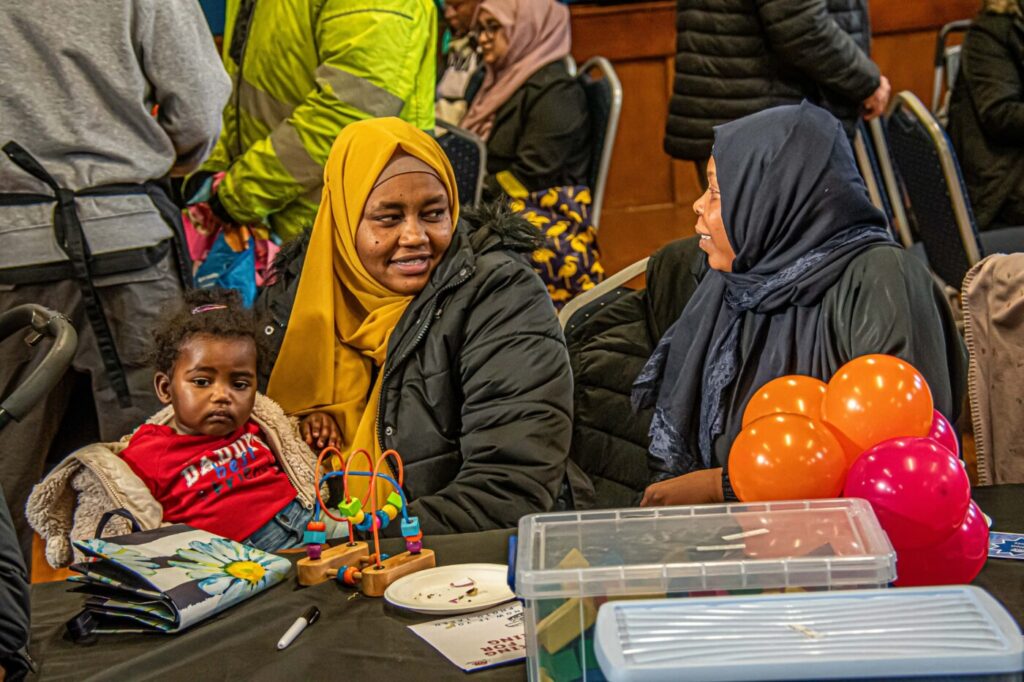
Two women and a toddler sitting chatting at a table

We’ve also completed new research into the financial value of Pantry membership. 

Members typically now save £27 each time they visit a Pantry, and over the past 12 months members across the country saved a total of £6.9 million!  

Pantries help people avoid crisis point

The millionth visit came at the same time as new research, showing that community food clubs such as Pantries are leading to a reduction in food bank usage and severe hunger.

Among Your Local Pantry members who had previously had to use a food bank, 71 per cent had been able to reduce or completely stop their food bank usage. Furthermore, 70 per cent of members who previously had to skip meals were doing so less often, since joining a Pantry or similar project.

One member said: 

“I have been able to eat meals instead of skipping them while my kids eat every meal. Before, I was skipping an evening meal every other day to make sure that there was food on the table for my children.”
Pantry member

This summer and autumn, Your Local Pantry and six similar organisations surveyed over 14,000 people who access membership-based food clubs. These projects typically operate at neighbourhood level, with local residents joining as members and accessing top-quality groceries in return for just a few pounds per visit.

Our survey found that as well as saving members money and helping them to avert crisis, Pantries are also bringing a range of social and health positives:

  • 82% of members surveyed said they feel more connected to their community
  • 97% say they’re more able to afford to eat balanced meals
  • 75% are eating more fresh fruit and vegetables
  • 83% say they feel less stressed or worried about running out of food

Pantries must be a big part of the solution

The surveys were coordinated by Feeding Britain and took place over summer 2025. An analysis of the combined results concluded that “food clubs represent one of the most promising place-based approaches to tackling hunger in the UK”. 

It said: 

“Food clubs can and must form a part of a multi-layered strategy to eliminate hunger from the UK, demonstrating that affordable, nutritious food can be a vehicle for transformation, not just survival, and that with strategic support, this transformation can be sustained and scaled.”
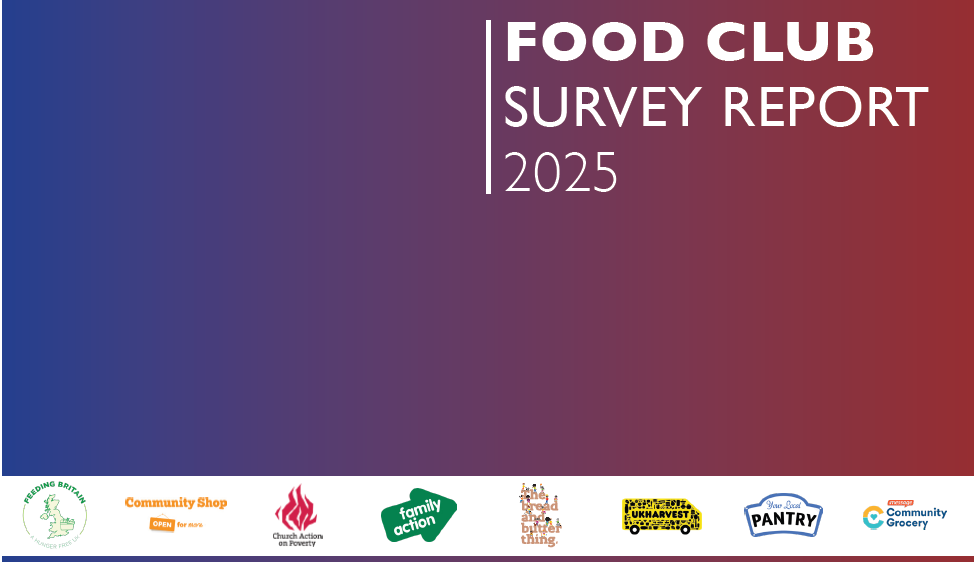
A cover image for the Food Club Survey Report 2025, including that text and several logos, on a blue-red background.
Food Club Survey Report

Pantries: What they say...

James Henderson, Your Local Pantry network coordinator: “Pantries are real places of hope that bring communities together, and enable people to unite and improve each other’s lives together. Reaching one million visits is a testament to the kindness and goodness of all the volunteers, members and supporters across the UK, but also to the effectiveness of the approach.

“Pantries are not a substitute for economic justice – the Government needs to step up to address the scandalous cost of living, and to ensure everyone has an adequate income to live on. But while we press for national change, membership food projects are incredibly transformative. Councils, faith groups or anyone else looking to make a difference would struggle to find a better way to support communities.”

Ed Powell, partner and impact manager at Co-op, a long-standing partner of Your Local Pantry: “Pantries are a progressive step forward to help local people own their access to food, and the powerful membership model has cooperation at its heart. Pantries aren’t just about food – now, more than ever, they show the power of food to bring people from different backgrounds together in community.”

Marie Gilluley, Chair of the SKylight Board in Stockport, where the first Pantries opened in 2013: “It’s remarkable to see how something that began in Stockport has grown into a network serving communities across the UK. Reaching one million visits is an important milestone and a reflection of the steady, dedicated work of our members, volunteers and partners who make each pantry possible.”

Two women sitting side by side, one with a hot drink and one with a pastry

Prayer, care and action: how Christians should respond to injustice

The amazing 11-year-olds uniting a community through food

Make Them Pay: We’re backing the call for a just tax system

Glory: How I’m striving for change and a better society

Church Action on Poverty Sheffield: 2025 pilgrimage

Empty Plate Project lets local people be heard

We have a new Chief Exec – and we’ll continue to be a catalyst for change!

Are churches losing faith in low-income communities?

“The cuts are deeply immoral and should be opposed by all Christians”

SPARK newsletter summer 2025

Let’s End Poverty: what comes next?

Faith, justice & awesome activists: Niall reflects on his 28 years

In a queue, and newly homeless, I realised: this is where change begins

Legacies: invest in a future without poverty

Sharing Power to Shape Mission

Activists work to shape policies of the future

Are churches losing faith in low-income communities?

Church Action On Poverty North East 2025 AGM

The Taxpayers Against Poverty logo

The moral case and a 3-point plan for tax reform

A poster reading: "Faith In The City: A call for action by church and nation"

Synod is about to debate poverty. Here’s what we long to hear…

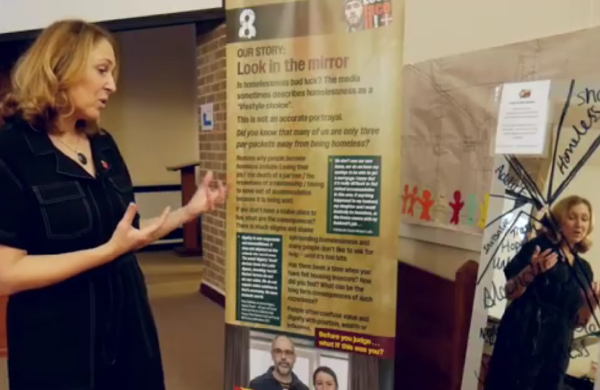
A woman stands beside a banner about homelessness, facing a mirror with words written on it.

How music and art helped churches grasp poverty

Our new roundtable guide will help churches or dioceses to host productive regional events

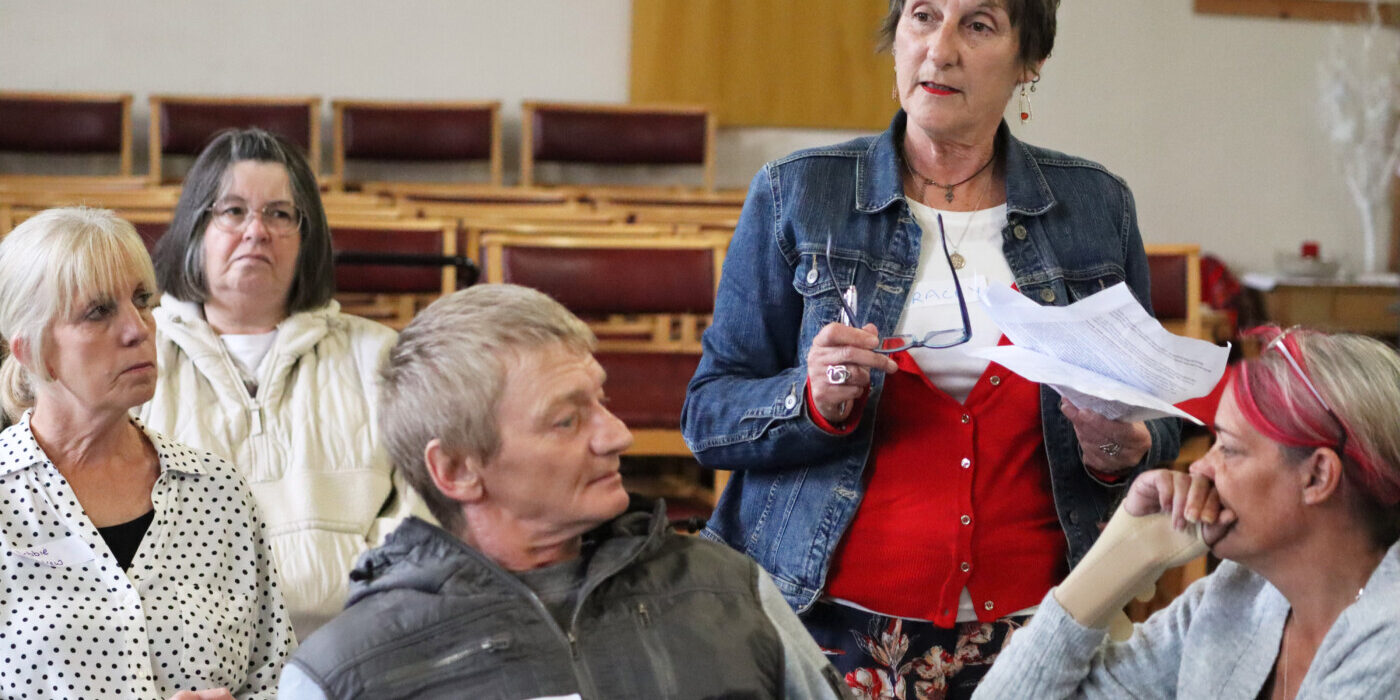
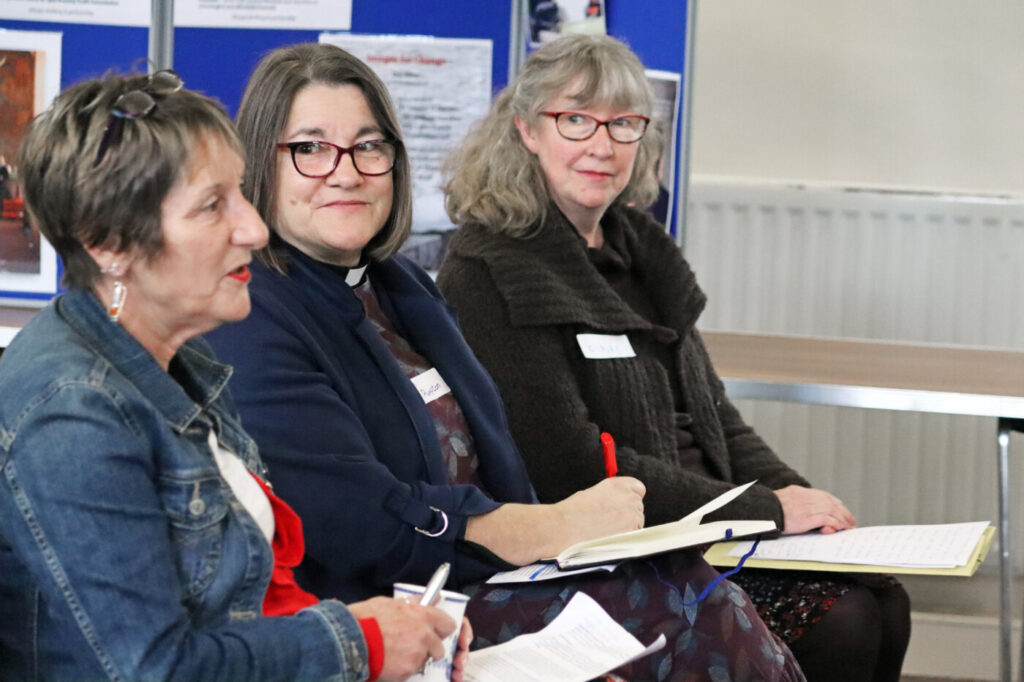
Three women sitting beside each other at the North East Roundtable

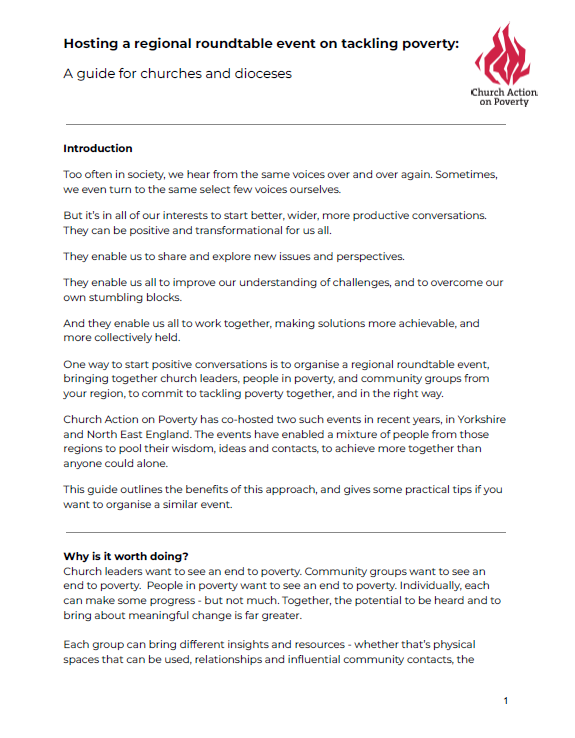
We’ve published a new resource for churches and dioceses who would like to start constructive regional conversations about tackling poverty.

Too often in society, we hear from the same voices over and over again, but if we want to make a real difference in social justice, we need wider, more productive conversations.  

One way to start is to organise a regional roundtable event, bringing together church leaders, people in poverty, and community groups from your city or region. 

Church Action on Poverty has co-hosted two such events in recent years, and we’ve learnt along the way.

This guide explains why such events are useful, and gives practical tips if you want to organise a similar event.

Why Christians can’t keep out of politics

26 in 26: 200 churches register for social justice idea

Pilgrims call for more support in low-income neighbourhoods

How should churches address rural poverty?

Faith In The City: why it still matters, 40 years on

Pantries reach 1 million visits – as new research proves they work

The Taxpayers Against Poverty logo

The moral case and a 3-point plan for tax reform

A poster reading: "Faith In The City: A call for action by church and nation"

Synod is about to debate poverty. Here’s what we long to hear…

A woman stands beside a banner about homelessness, facing a mirror with words written on it.

How music and art helped churches grasp poverty

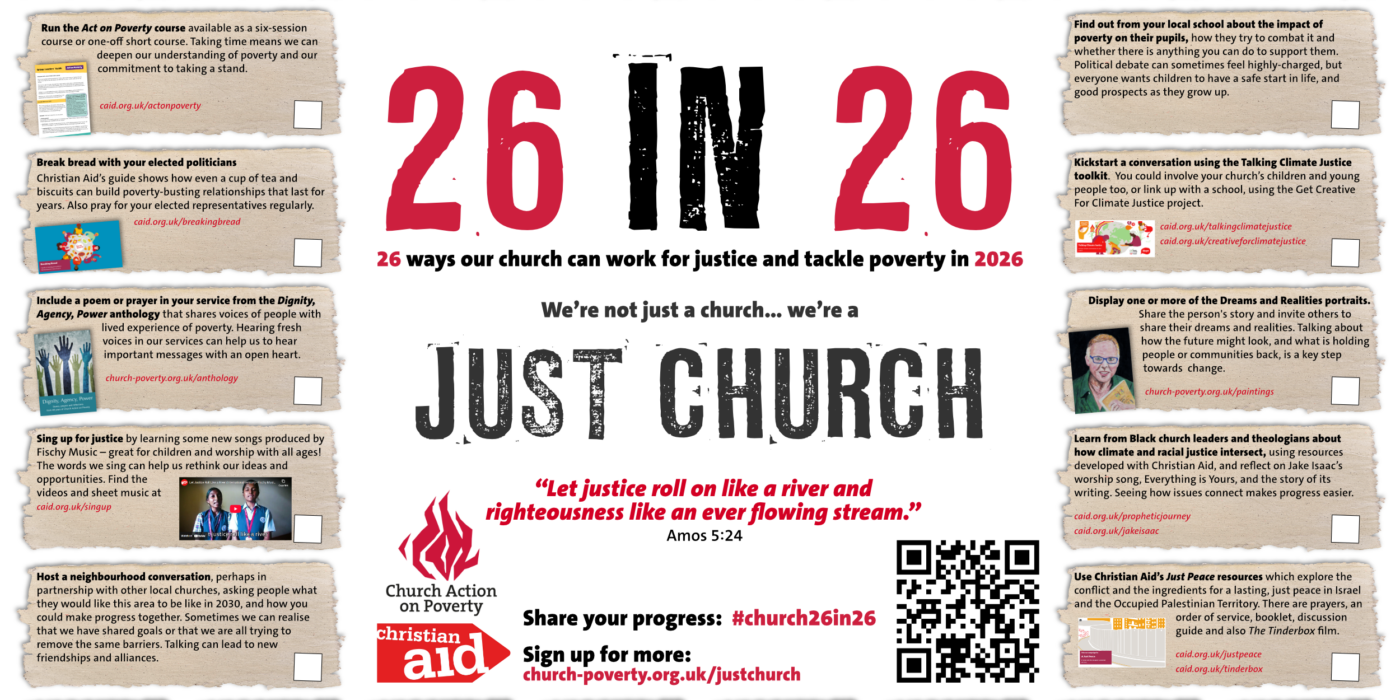
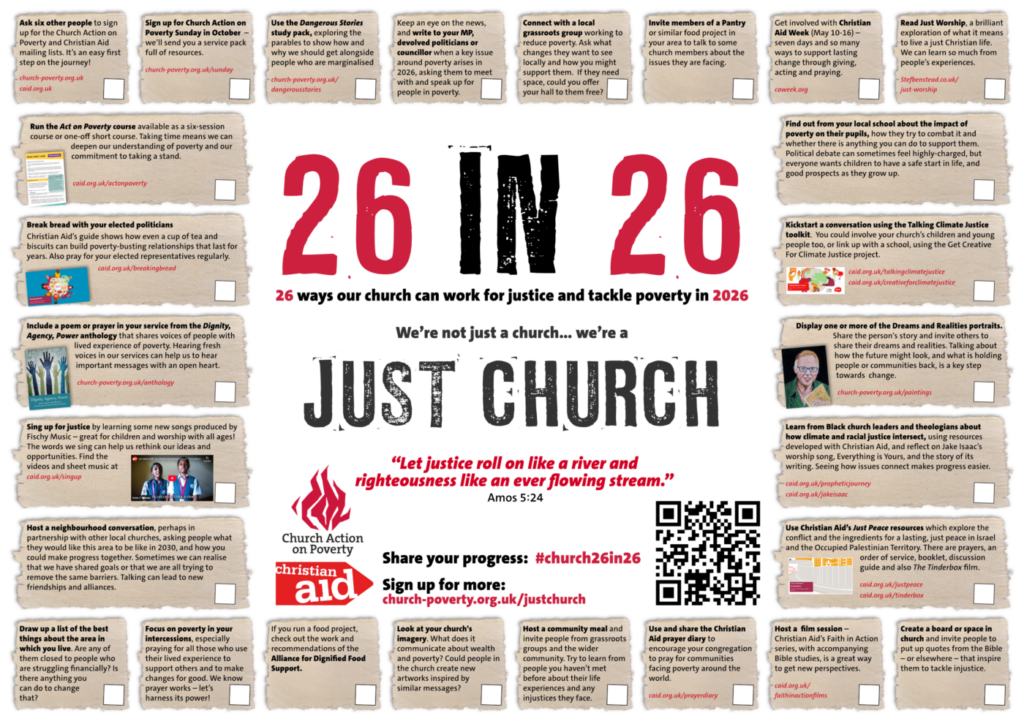
A poster reading "26 in 26", surrounded by 26 text boxes

Justice is integral to our faith. Church Action on Poverty and Christian Aid have teamed up to produce a new poster that your whole church can use throughout 2026.

The poster contains 26 ideas that you and your church could try in 2026.

Some are very easy, some will take a bit more planning, but all are worthwhile.

We’ve sent this to all churches on our existing mailing lists and we’ve also now received 200 new sign-ups for posters. If you too would like a copy then you can download or order it above. 

Let justice roll on like a river and righteousness like an ever flowing stream.
A Bible
Amos 5:24

How to use the poster

  1. If you’re printing your own copy, please print in colour in A3 size. If you’ve ordered a posted copy, it will be on its way.
  2. Display it where lots of people will see it – perhaps in your church hall, or near the entrance, or wherever you share teas and coffees! 
  3. Encourage church members and staff to look through the ideas and take responsibility for making some of them happen.
  4. Mark them off as you go
  5. Let us know how you get on! You can email us, or use the hashtag #church26in26.

A call to action

One of the first churches to sign up was Parson Cross Methodist Church at Mt Tabor in Sheffield. 

Pioneer minister Nick Waterfield said: 

"We need to become a Just Church through our actions, and not just talk about it. As Nelson Mandela famously said: 'Do not look the other way; do not hesitate. Recognise that the world is hungry for action, not words'."
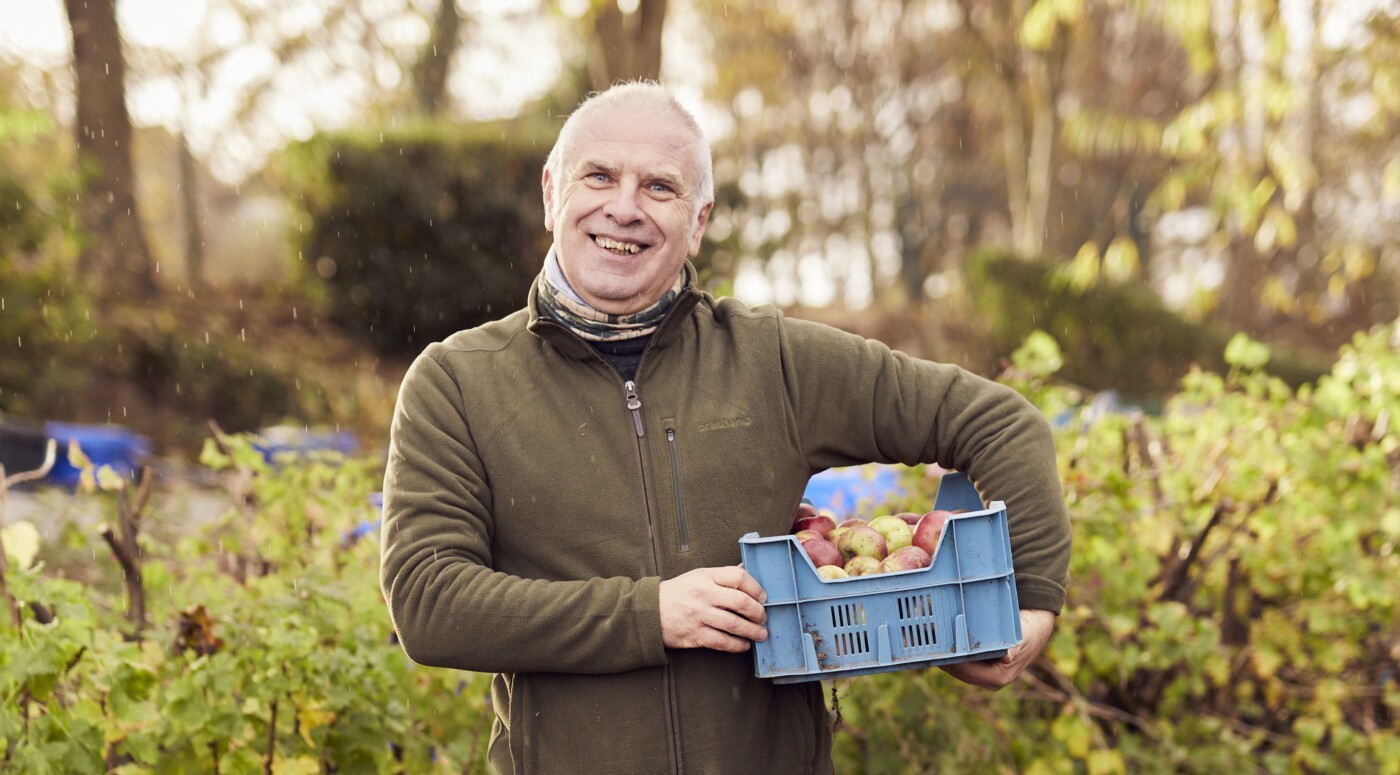
Nick Waterfield outdoors, holding a crate of apples
Nick Waterfield
Pioneer minister, Sheffield

26 in 26: 200 churches register for social justice idea

Pilgrims call for more support in low-income neighbourhoods

How should churches address rural poverty?

Faith In The City: why it still matters, 40 years on

Pantries reach 1 million visits – as new research proves they work

Grief is hard enough: it’s time to improve funeral support

New toolkit: Hosting a regional anti-poverty roundtable

The Taxpayers Against Poverty logo

The moral case and a 3-point plan for tax reform

A poster reading: "Faith In The City: A call for action by church and nation"

Synod is about to debate poverty. Here’s what we long to hear…

A woman stands beside a banner about homelessness, facing a mirror with words written on it.

How music and art helped churches grasp poverty

A stock image of a Lady Justice statue, with the Church Action on Poverty logo alongside

In this guest sermon, John Davies from Liverpool reflects on the parable of the unjust judge and the persistent widow

Readings: 2 Timothy 3:14-4:5, Luke 18:1-8 

“From childhood you have known the sacred writings,” wrote St Paul. Is that true for you? We all have our different stories when it comes to the background and the development of our faith.

I was brought up in a Baptist church, where the preaching and teaching of the Word of God was central to our Christian life. In that church each service begins with a short procession, when out of the vestry come the minister and elders, the first elder carrying a big leather-bound bible, and when that elder steps into the sanctuary, the congregation stand.

It is a powerful statement of how important the scriptures are to that community of Christians. It’s like when, in our communion service, we stand to hear the gospel reading: a sign of our respect for the Word. 

A stock image of a Lady Justice statue, with the Church Action on Poverty logo alongside

Discovering God's devotion to justice

In my early years I valued the teaching I received from ministers and youth leaders who “unfolded the sacred writings” in ways which brought those words alive for me; people who challenged me to read and reread scripture to discover its hidden wealth; people whose teaching challenged me to apply what I’d heard to how I lived. 

After all, there’s no point knowing about the scriptures if you ignore what they say. Paul wrote that “they instruct you for salvation through faith in Christ Jesus”. They instruct you for salvation: they show you how to walk in God’s saving way. 

In my late teens and twenties I was especially challenged by teachers who opened up to me the image of a God who is alive and active in the affairs of the world and deeply devoted to justice and righteousness, justice focussed on the protection of society’s poorest and most vulnerable people; a God who demands that we live our lives in this way. As the letter of James puts it:

“Religion that is pure and undefiled before God, the Father, is this: to care for orphans and widows in their distress, and to keep oneself unstained by the world.”
A Bible
James 1:27

The unjust judge and the persistent widow

I think we can see that the woman in today’s parable clearly believed this. It would appear that she, a widow, thus one of the poorest and most vulnerable people in town, knew her scriptures, and believed what the laws of Moses said about protecting the likes of her from ruin. She was so convicted by this that she persisted in asking the judge for justice against her opponent. 

Jesus didn’t say who her opponent was, or what type of justice she sought. He may have been her landlord who had evicted her with no explanation and without warning. Or he could have been her creditor who had increased the interest on her loan by a huge, unaffordable, amount. 

Neither did Jesus say why the judge was so reluctant to grant the woman a hearing – only that “he had no respect for God or for others”, as he clearly showed by the way he treated this widow. 

A lesson in speaking truth to power

We can speculate that the woman’s legal opponent was an influential person in the same social circle as the judge, let’s say an old school friend or his pal from the golf club, who he would be naturally inclined towards helping. The woman’s opponent may have even given the corrupt official some financial inducement to guarantee that he would not hear her case. [1]

Clearly if the judge read the scriptures at all, he read them in quite a different way than the widow, for the powerful are adept at manipulating God’s laws to benefit themselves. But she held fast to her principles, repeatedly challenging his resistance to her appeals until she was eventually heard. 

This is a parable about speaking truth to power. Most of the power in the relationship rested with the judge, and with the woman’s legal opponent who the judge demonstrably favoured. But the woman had something arguably more powerful than he did – she had her truth, which she insisted on telling, her persistence eventually wearing out the judge’s indifference.

Stock image of Liverpool from pixabay
A stock image of Liverpool. Christians in the city have spent many years working tirelessly for social justice.

We can take confidence and courage from this story

I think the scriptures can give confidence to people today who want to challenge the powers that be, about the situations that are causing them harm. Today is Church Action on Poverty Sunday, an opportunity to reflect on the work of that organisation. Years back I helped to organise an event which we called the Liverpool Poverty Hearing which took place just days before the 1997 General Election. 

On that occasion, held in a city centre Friends Meeting House, eight people with direct experience of living in real poverty in Liverpool were courageous enough to share their stories with an audience of the city’s decision-makers, business leaders, and parliamentary candidates. Their truthful, expert, voices were for once given a platform to be heard. The powerful ones were there to listen, and learn.

Karen from Norris Green spoke of the pain of having to face leaving Liverpool to gain meaningful work and move out of the poverty trap she was in.

Barbara from Everton suggested that poverty now was worse than in earlier generations because of an increase in social isolation.

Matt from Everton spoke of life on invalidity benefit – no cinema, no books, no means to make provision for his long term illness – and asked, “do I have to live in poverty all my life?”.

Jo, a graduate unable to find work, described life on £44 a week.

Dawn from Kirkdale, a mother of four, her partner on a wage just £1 above unemployment benefit, described the pain of being unable to provide properly for her young ones.

Ann, homeless through a series of events linked to her estranged husband’s violence against her, said that she’d be dead if she’d stayed with him and asked, “Why, because I chose to stay alive for the sake of my children, should I be forced to live a life in poverty?”

And Eric from Everton explained the ‘benefit trap’ that he and his wife were in because of her low income job. [2] 

As a consequence of that meeting we formed Merseyside and Region Church Action on Poverty; and in the intervening years members have continued their campaigning, carried on organising events of these kinds.

Some of our grassroots people have been involved in parliamentary consultations and face-to-face meetings with ministers. And, in those rare and special times when the powerful truly stopped to listen, these consultations contributed towards some genuinely positive changes of policy.

So, today, we give thanks for Church Action on Poverty; people doing the same work today as the woman in Jesus’ parable, whose persistence overcame the resistance of the powerful ones.


A prayer for Church Action on Poverty Sunday

God, we pray for your mercy upon those who hurt, those whose voices are silenced, those who faithfully persist in speaking truth to power: We pray for those silenced for speaking out against corruption, and for those who continue to demand justice; for those silenced for speaking out against greed; and for those who continue to cry out for a fairer distribution of wealth. God, in your mercy, hear our prayer. [3]
A Bible
by Ana Gobledale

Footnotes

[1] William Herzog, Parables as Subversive Speech: Jesus as Pedagogue of the Oppressed; pp.215-232, ’Justice at the Gate?’

[2] John Davies, The truthful, expert voices. Notes from a Small Vicar, 17 October 2006. Church Action on Poverty: www.church-poverty.org.uk. 

[3] Ana Gobledale, Prayers arising from Amos 7; quoted in Church Action on Poverty, Speaking Truth to Power resources [PDF], 23 February 2020.

Sign up below for this Sunday's online service

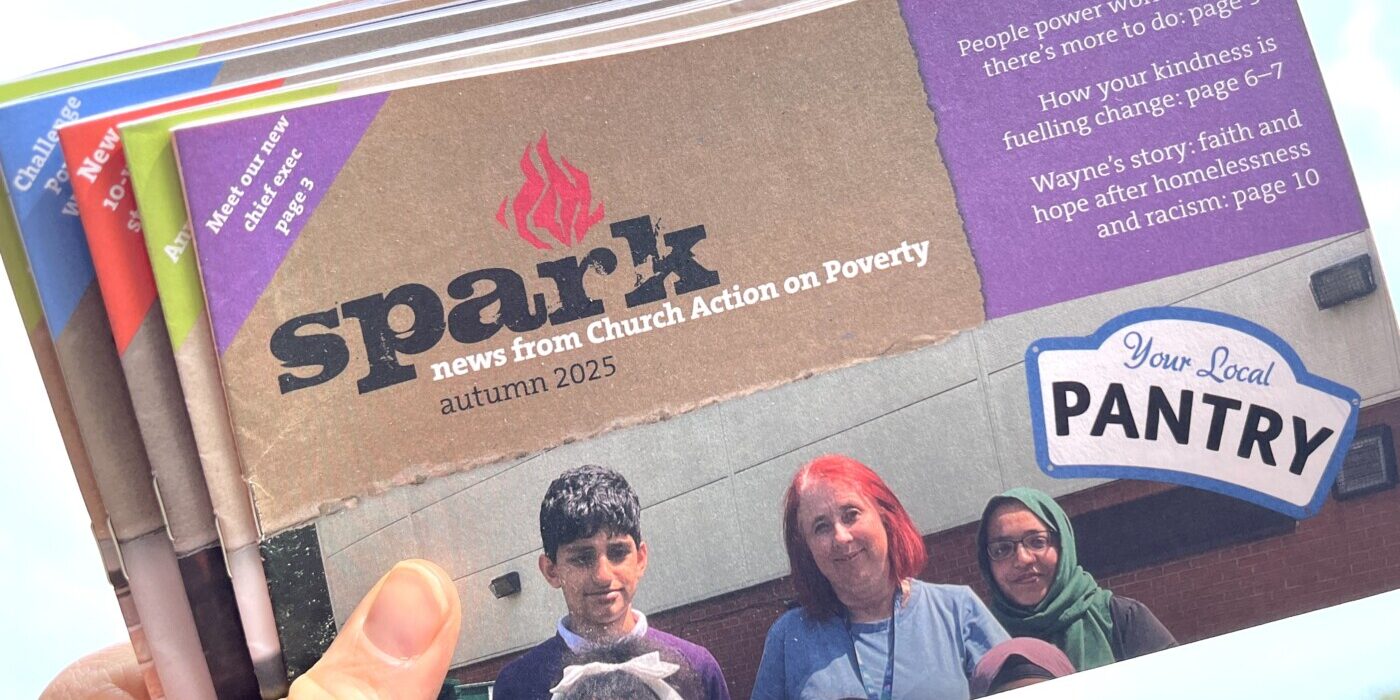
A hand holding a bundle of Spark newsletters

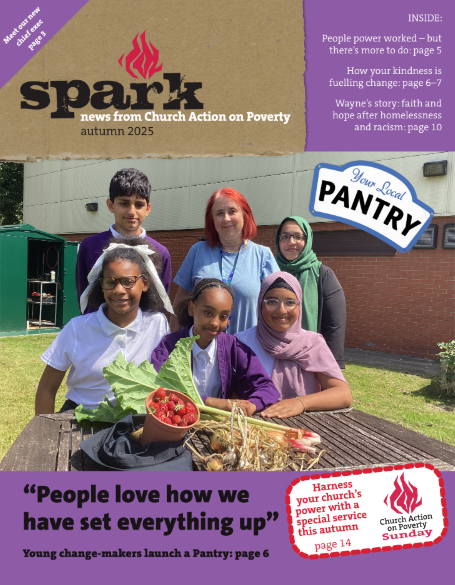
Click on the cover image to download the latest issue of our SPARK newsletter, full of stories, ideas and reflections.

New toolkit: Hosting a regional anti-poverty roundtable

Annual review 2024-25

A stock image of a Lady Justice statue, with the Church Action on Poverty logo alongside

On poverty and justice: A sermon and prayer for this week

An evening photo of the House of Commons, from across the Thames

The Make Them Pay march this Saturday (September 20th) will see thousands of people demanding that the Government introduce a just tax system. We back them.

Marchers are demanding the UK Government take substantive action to tax extreme wealth and polluting corporations, so the country can re-invest in public services, protect workers, and tackle the climate crisis.

The demonstration will assemble at Portland Place, London at 12 noon on Saturday 20 September and has been organised by the ‘Make Them Pay’ coalition, a civil society alliance made up of 70+ organisations, including Church Action on Poverty, Global Justice Now, the Climate Justice Coalition, War on Want, the PCS Union, the Fire Brigades Union and more. Organisers have stated they expect thousands of people to take to the streets.

Three key demands

Their protest aims to rally support for three key demands: 

  1. Taxing the super rich to fund public services
  2. Creating decent, well-paid and unionised jobs in sustainable industries around the country
  3. Making polluting corporations foot the bill for climate action.

Why Church Action on Poverty supports the campaign

Liam Purcell, chief executive of Church Action on Poverty, says::
 
More and more people are being swept into poverty by an ongoing cost-of-living scandal, a lack of decent work, and inadequate benefits. It reflects a society that places more value on some people than others. We urgently need real action to build a world where everyone can exercise dignity, agency and power. It's great to see people standing up today for that vision. Together, we have hope and we can work for change.
Liam Purcell
Chief exec, Church Action on Poverty

Make Them Pay: We want and deserve better

Izzie McIntosh, one of the lead organisers for the Make Them Pay demonstration says:

“Energy bills are rising, living standards are going down, climate change is destroying communities, and the super-rich are raking in the profits – all at our expense. No more. This September we will take to the streets, united in our thousands to demand our government makes them pay. While our political leaders roll out the red carpet to Trump – a megalomaniac bully who is bankrolled by billionaires and big oil – we will be on the streets representing the interests of ordinary people in this country, united in our diversity from all backgrounds and walks of life, who want and deserve better.”

Make Them Pay: Put people and planet before a wealthy few

Asad Rehman, chief executive of Friends of the Earth, says:

“As people in the UK struggle to put food on the table or pay for extortionate energy costs and rents, billionaires and greedy corporations are getting filthy rich off the rest of us. It’s unforgivable that such a small but powerful minority is being allowed to amass extreme wealth while so many are facing desperate levels of hardship, and our planet pays the price for their reckless exploitation and overconsumption of its resources.

“People are waking up to the fact they’re being played by those who know how to game the system. That’s why we’re coming together in a bid to reclaim our power – because there’s strength in numbers – and to tell the government it must put people and planet before the interests of a wealthy few.”

Fariya Mohiuddin, Deputy Director: External Affairs at Tax Justice UK says:

“Millions of people in the UK want to see politics make their lives better; particularly after years of struggling to meet basic needs compounded by an erosion in public services like healthcare, childcare, and water.

“Despite a change in government, all we’re seeing is politics continuing to work in the interests of the super-rich and powerful who have continued to increase their wealth.

“This is underpinned by a tax system that has one set of rules to protect and grow the wealth of the super-rich, and another set for everyone else.

“It’s high time the government ends this two-tier system and taxes wealth properly, starting with a wealth tax and making sure wealth and work are taxed the same. This revenue can help to make childcare affordable, healthcare available and making lives better. Poll after poll shows clearly that, if the government fails to make people feel an improvement in their lives, they will lose the next election.”

Steve Wright, Fire Brigades Union general secretary says:

“Firefighters are on the frontline of the climate emergency, battling to keep the public safe from increasing wildfires and floods. But with 1 in 5 firefighter posts lost to austerity since 2010, the fire and rescue service is in a state of emergency. While public services have been cut to the bone, the oil and gas giants fuelling this crisis are raking in profits. Billionaires are hoarding more wealth than ever, and the rich continue to get richer at our expense. We demand that the government introduces a wealth tax to fund public services, create jobs, and build an economy that serves ordinary people instead of the super-rich.”

Make Them Pay: A growing case for change

Recent months have seen demands for a wealth tax in the UK – an annual levy on assets aimed at the ultra-wealthy in society – gain more prominence. The UK has a very high level of inequality, with the country’s 50 richest families holding more wealth than 50% of the population. Modelling from Tax Justice UK, shows that a 2% levy on individuals who own assets worth more than £10 million – which would affect only 0.04% of the UK population – would raise £24 billion a year. Meanwhile, energy bills in the UK are set to rise once more from October, affecting around 20 million households.

Annual review 2024-25

On poverty and justice: A sermon and prayer for this week

New: The Autumn 2025 Spark newsletter

Prayer, care and action: how Christians should respond to injustice

The amazing 11-year-olds uniting a community through food

Make Them Pay: We’re backing the call for a just tax system

Glory: How I’m striving for change and a better society

Church Action on Poverty Sheffield: 2025 pilgrimage

Empty Plate Project lets local people be heard

We have a new Chief Exec – and we’ll continue to be a catalyst for change!

Are churches losing faith in low-income communities?

“The cuts are deeply immoral and should be opposed by all Christians”

SPARK newsletter summer 2025

Let’s End Poverty: what comes next?

Faith, justice & awesome activists: Niall reflects on his 28 years

The Taxpayers Against Poverty logo

The moral case and a 3-point plan for tax reform

A poster reading: "Faith In The City: A call for action by church and nation"

Synod is about to debate poverty. Here’s what we long to hear…

A woman stands beside a banner about homelessness, facing a mirror with words written on it.

How music and art helped churches grasp poverty

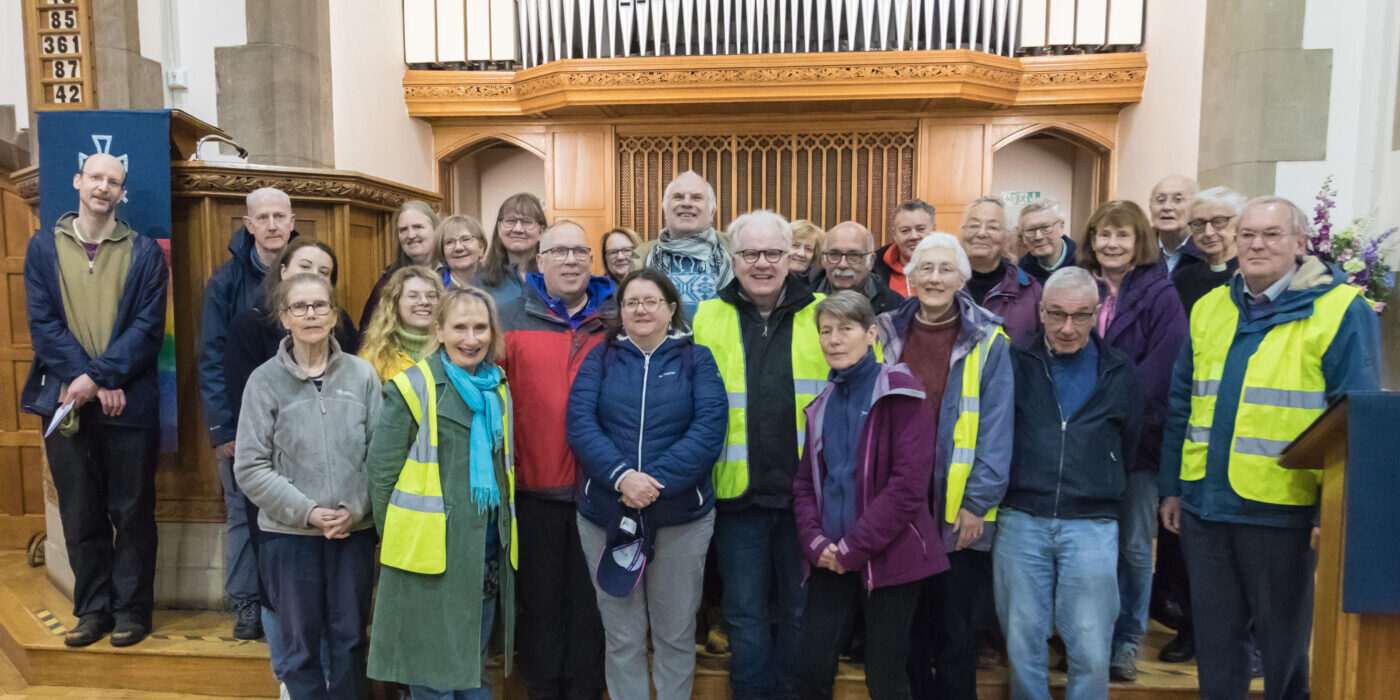
A group of people in front of a church organ. Some are wearing high-vis.

16th annual pilgrimage

Saturday 11 October, 2025

Hear about local issues and responses, as we walk and pray together

A group of people in front of a church organ. Some are wearing high-vis.

Gather: 9am, St Cuthbert’s Church, Barnsley Road, Sheffield (opposite the Northern General Hospital) for a 9:30am start.

Visit: St Cuthbert’s Church, Wincobank Wood, Upper Wincobank Undenominational Chapel and Firth Park Methodist Church, with stops at relevant places to pray for education, healthcare and the environment.

Meet: People tackling local social challenges.

Length: 2.5 miles

End: 2:30pm

Join us and learn about:

  • The challenges faced by this diverse and multicultural area.
  • The Fir Vale Food Bank at St Cuthbert’s, offering help to all in need throughout the year without the need for an official referral.
  • Wincobank Nondenominational Chapel, founded in 1841 by Mary Ann Rawson, the famous anti slavery campaigner.
  • The work of Firth Park Methodist Church, with its ‘Food for Thought’ lunch, community and Warm Space facilities and Sam’s Space soft play facilities.

Practicalities

  • This year’s Pilgrimage involves some upward gradients of around 4% over distances of around just one mile, so please think carefully about your fitness to tackle these gradients.

  • St Cuthbert’s is best reached by public transport.

  • A number of buses serve the Northern General Hospital, including the 29 between Fir Vale and High Green, 47/48 between Shire Green and Herdings, 75/76 between Low Edges and Meadowhall and the 88 between Bents Green and Ecclesfield, which all stop on Barnsley Road, opposite the church.

  • The Pilgrimage ends at Firth Park, which is also served by a number of buses, including the 75/76 and the 88, mentioned above, and the 18 between Heeley and Hillsborough.

  • Parking is limited close to the start of the Pilgrimage and participants would have to walk or get a bus back to the Northern General Hospital to pick up their cars.

  • Please follow stewards’ advice, particularly at road crossings.

  • Walkers take part at their own risk, please wear suitable footwear and bring a waterproof. Anyone under 18 must walk with a responsible adult.

  • The event is not suitable for dogs as we enter premises.

  • We will stop for lunch at Firth Park Methodist Church. Please bring your own packed lunch and drinks.

  • Some locations we visit have toilet facilities.

Come and be open and be challenged and changed by what you see and hear

For more information or to register to attend, contact Briony Broome at Church Action on Poverty Sheffield on 07801 532 954 or send an email by clicking below.

Faith In The City: why it still matters, 40 years on

Pantries reach 1 million visits – as new research proves they work

Grief is hard enough: it’s time to improve funeral support

New toolkit: Hosting a regional anti-poverty roundtable

Review: The Perils of Universal Credit

Annual review 2024-25

On poverty and justice: A sermon and prayer for this week

New: The Autumn 2025 Spark newsletter

Prayer, care and action: how Christians should respond to injustice

The amazing 11-year-olds uniting a community through food

The Taxpayers Against Poverty logo

The moral case and a 3-point plan for tax reform

A poster reading: "Faith In The City: A call for action by church and nation"

Synod is about to debate poverty. Here’s what we long to hear…

A woman stands beside a banner about homelessness, facing a mirror with words written on it.

How music and art helped churches grasp poverty

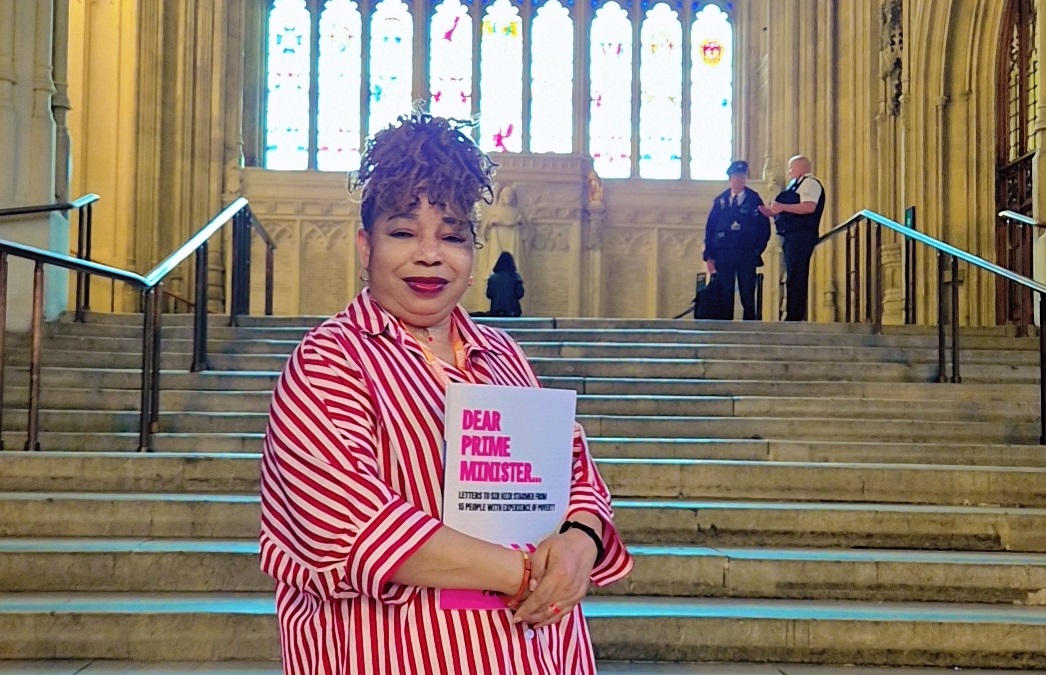
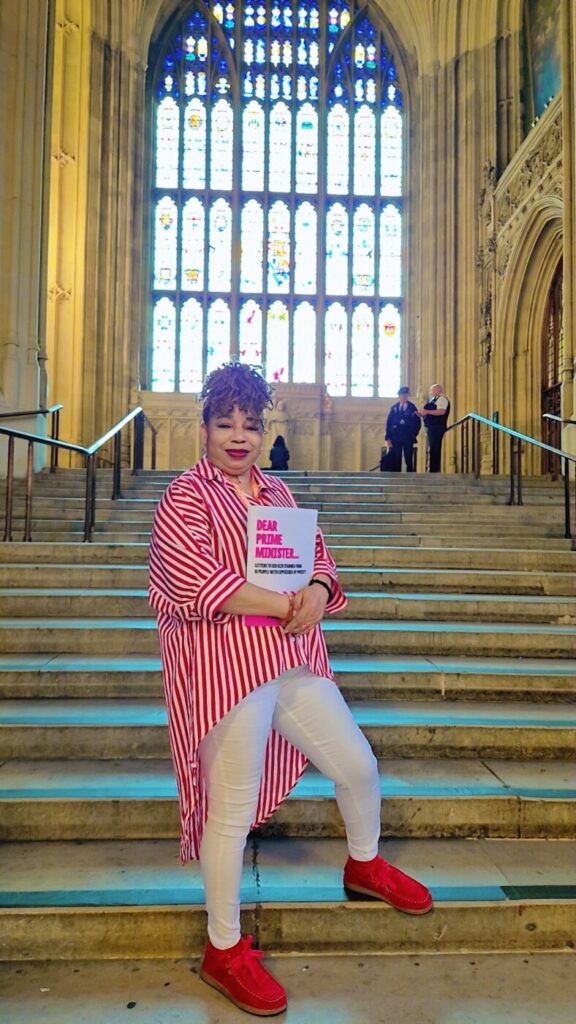
Glory holding the "Dear Prime Minister" booklet, standing on a staircase in the Houses of Parliament.

Change happens when people work together to demand it, and we love hearing inspiring stories of people doing just that.

This blog showcases the experiences of Glory Omoaka, who has worked with a huge range of people and groups to challenge the injustices she has encountered, and to remove hurdles for other people. 

In recent years, Glory has:

  • Helped to change the unjust funding rules that denied her vital support for her nursing training.

  • Campaigned for more dignified approaches to help people going through food insecurity.

  • Worked with The Food Foundation on a range of campaigns to empower low-income communities.

  • Joined a Poverty Truth Commission in Scotland to help shape systems where she lives

  • Become a trustee with Church Action on Poverty, to help drive change across the UK

  • Been one of the leading voices in the Let’s End Poverty work.

What motivates Glory to consistently step up?

“I want change. I want a better society. I want to see smiles on people’s faces, and to see things done in the right way.”

A portrait photo of Glory holding the "Dear Prime Minister" booklet, standing on a staircase in the Houses of Parliament.

Glory's introduction to activism

One of Glory’s first campaigning experiences came when she was doing her nursing qualifications in Glasgow, with the aim of working in the NHS. Glory was born in Nigeria, but the rules on student funding for people born outside the UK were very outdated, and she was being denied support that other students could access. Glory could see that the world of work was evolving, and the rules needed to be reformed.

The Poverty Truth Commission in Scotland helped arrange meetings with Ministers, but only after taking a legal case was she given the support she was due – but she then faced similar inequality while continuing her training. Other student nurses were awarded funding to help with travel costs to their placements, and other expenses, but Glory was not. 

“I struggled and struggled through the pandemic, and was watching my coursemates accessing support and enjoying their studies while I was struggling. It was not a fair system. Even though I was down, I wanted to stay to the end. There was another woman in the same situation and she took Legal Aid to get a lawyer, and with the support of the charity JustRight Scotland, we took the case and won, and the long-term residency rules were changed. 

“I went through some horrible situations, I do not have the words to describe what I went through, but I have always wanted to help people, and I have often met with MPs or MSPs to show what should change.”

Following that relationship, Glory has been a member of JustRight Scotland’s panel.

Glory: food in focus

Another of Glory’s big areas of focus has been food. During the Covid lockdowns, some councils were giving low-income families vouchers that could only be used in certain shops, and Glory was among the groups calling for more dignified cash payments instead.

She has also encouraged community food projects to ensure they offer a diverse range of food, to reflect the cultures and backgrounds of different groups, and is also involved in campaigns to reduce sugar and junk-food advertising.

“We are also campaigning for free school meals to be extended and to be allocated automatically, so people who don’t have internet access or struggle with filling in the form are not left out. And I also volunteer with the Dignity project with Nourish Scotland, working to ensure people who access food banks are treated in a dignified way.

“When I first went on to Universal Credit, I was given a food bank voucher but I did not need it immediately, so saved it. When I then tried to use it, I was told it had expired and I was called terrible names and called a thief. I did not want anyone else to go through this, so I have been campaigning in this regard, to give holistic support to people at food banks.”

Glory is also a member of Nourish Scotland’s meaningful participation panel, and also a Food Foundation ambassador, which involves talking about poverty and food insecurity, and campaigning for things like free school meals, and helping to support families. 

Challenging UK poverty

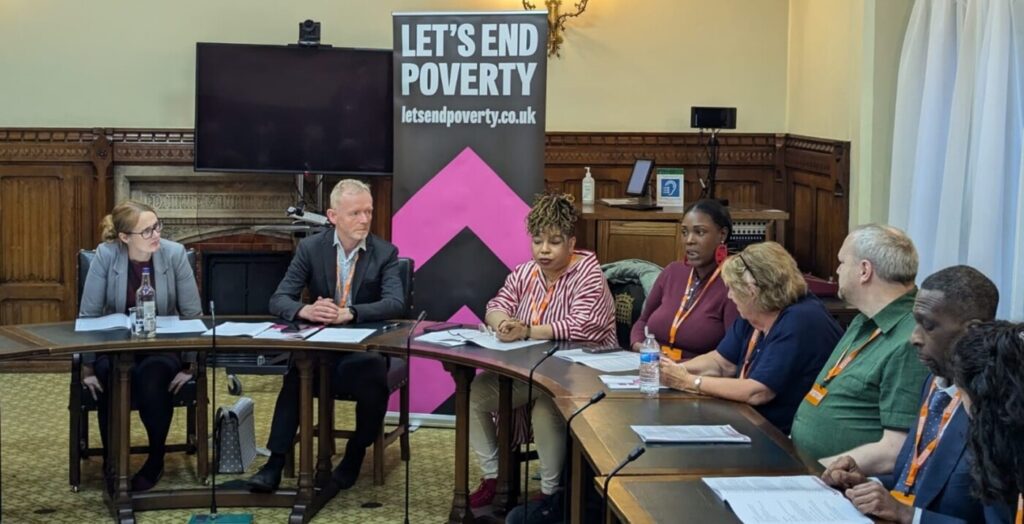
People sitting at a curved line of desks, in front of a Let's End Poverty banner

In 2023-24, through her work with the Poverty Truth Commission in Glasgow, Glory was introduced to the Let’s End Poverty campaign, and became a member of the steering group.

As part of that, she was one of 15 contributors to Dear Prime Minister, a collection of letters to Sir Keir Starmer from people with personal experience of poverty, and she attended the launch event at the House of Commons.

“It felt very good doing that. How rare it is to have an opportunity to express your experience and to have a voice. Even if the outcomes are slow, it gives a relief. I was happy with that opportunity and hope that work continues. Through Let’s End Poverty, I met Church Action on Poverty, and now I have become a trustee.” 

Review: The Perils of Universal Credit

Annual review 2024-25

On poverty and justice: A sermon and prayer for this week

New: The Autumn 2025 Spark newsletter

Prayer, care and action: how Christians should respond to injustice

The amazing 11-year-olds uniting a community through food

Make Them Pay: We’re backing the call for a just tax system

Glory: How I’m striving for change and a better society

Church Action on Poverty Sheffield: 2025 pilgrimage

Empty Plate Project lets local people be heard

We have a new Chief Exec – and we’ll continue to be a catalyst for change!

Are churches losing faith in low-income communities?

“The cuts are deeply immoral and should be opposed by all Christians”

SPARK newsletter summer 2025

The Taxpayers Against Poverty logo

The moral case and a 3-point plan for tax reform

A poster reading: "Faith In The City: A call for action by church and nation"

Synod is about to debate poverty. Here’s what we long to hear…

A woman stands beside a banner about homelessness, facing a mirror with words written on it.

How music and art helped churches grasp poverty

Four children sitting at a wooden picnic table outside a plain building.

This inspiring story tells of five 11-year-olds, who have become the youngest people in the UK to launch a Pantry.

Makayla, Ahmad, Retaj, Ayman and Mustafa created the Pantry at Marlborough Community Hub, a community building in the grounds of Marlborough Road primary school in Salford as part of a leadership project, with support from staff. 

Four children and two adults sitting at a wooden picnic table outside a plain building.

What the children say:

Ayman: “Everyone was talking about how we could help the community, and make it more fair for everyone. We wanted to help with the financial situation and help people come together, because this is not just for food. I hope it becomes well known then becomes a really big help. This can help our community. It’s been very busy and people love how we have set everything up and made it very affordable, especially for people in hard financial situations. 

“We are a welcoming diverse school and we are very unique, especially now that we’re the first children in the country to open a Pantry!”

Ahmad: “It will help the community by lowering costs and making it more affordable to eat.”

Retaj: “My hope is for it to grow and for my parents to come and shop here and for it to be more affordable.”

Makayla: “I’m proud. Not every school could do something like this.”

Mustafa: “We all thought about people in need and we wanted to comfort and help people around us, and we talked about what we could do in the Pantry.”

Four primary school children in a line, facing the camera
From left: Ahmad, Retaj, Makayla and Ayman

How they did it...

The children worked on the Pantry idea as part of a leadership project when they were in Year 5.

The Pantry was all ready to open a year ago, but was then badly damaged by a serious fire that began in the lighting, the day after the soft launch, which forced a big rebuilding project.

A pop-up stall was used while the damage was repaired, but the Pantry was completed again in time for the children to see it before they moved on to secondary school this summer. 

Judith Richens, community development lead at the hub, said she was hugely proud of the children. There are 48 first languages at the school, and Judith said the children had excelled in explaining the Pantry to families and translating for people.

They also visited a Pantry in Stockport to see how it works, and talked about their idea to other schools in their academy trust., United Learning

Primary children in purple and white school uniforms picking raspberries
The children pick raspberries in the Pantry allotment

We'll work together, see what matters and make it happen

Judith says: “What particularly attracted me to the Pantry rather than a social supermarket or a food bank, is the membership idea. It is for members and run by members, and people choose and shop, rather than someone assuming what people are to have, and saying ‘this is what we’re giving you’.

“We also have an allotment next to the building to grow food for school dinners, and to provide fruit and veg for the Pantry, and there’s the added bonus of reducing the carbon footprint of the school. 

“This space is not just a Pantry. It’s an opportunity to meet people, and with other projects it becomes a wrap-around support service.

“Our ultimate aim, wider than the Pantry, is for this community space to be used by the community for the community. We are listening to what people want and finding out what matters and helping use people’s gifts and talents to make it happen.”

The Pantry also has an allotment, created by the previous year’s pupil project, including rhubarb, onions, raspberries, carrots, courgettes, flowers, strawberries, garlic and potatoes, and a hedgerow of other edibles, created with City of Trees.

The Community Hub is supported by Your Local Pantry partner, United Communities, a charity that supports the development of place-based, school-linked community hubs.

Raised beds in a large garden area, in front of a plain building
Raised beds in the fruit and veg garden at Marlborough Road Pantry

Pantry can bring the community together

Shumaila Taswir, Ayman’s mum and  lead volunteer, says: “I hope it will bring the community together and help people in difficult times. Most people are struggling but do not like to say. 

Here, they can come and choose whatever they want, and socialise here as well.”

The Pantry will be open every week, with a daytime session and an evening session. The evening slot will double as a drop-in session with Barnardo’s, for local 16 to 20-year-olds living independently.

There will be a cafe area and the Pantry has teamed up with Neighbourly and local Aldi and M&S stores, to help source extra stock.

On poverty and justice: A sermon and prayer for this week

New: The Autumn 2025 Spark newsletter

Prayer, care and action: how Christians should respond to injustice

The amazing 11-year-olds uniting a community through food

Make Them Pay: We’re backing the call for a just tax system

Glory: How I’m striving for change and a better society

Church Action on Poverty Sheffield: 2025 pilgrimage

Empty Plate Project lets local people be heard

We have a new Chief Exec – and we’ll continue to be a catalyst for change!

Are churches losing faith in low-income communities?

“The cuts are deeply immoral and should be opposed by all Christians”

SPARK newsletter summer 2025

Let’s End Poverty: what comes next?

Faith, justice & awesome activists: Niall reflects on his 28 years

In a queue, and newly homeless, I realised: this is where change begins

Legacies: invest in a future without poverty

The Taxpayers Against Poverty logo

The moral case and a 3-point plan for tax reform

A poster reading: "Faith In The City: A call for action by church and nation"

Synod is about to debate poverty. Here’s what we long to hear…

A woman stands beside a banner about homelessness, facing a mirror with words written on it.

How music and art helped churches grasp poverty

A stock image of an open hand, palm upwards

Guest writer Greg Smith shares a personal story of injustice in the care system, and urges churchgoers to demand better from our society.

We first met Precious two years ago when she turned up to morning worship.

She had recently arrived with her nine year old child from one of Britain’s former colonies. She asked for prayer that she might be able to find additional care work with a better employer, and a school place.

The vicar and I arranged to meet up with her during the week to find out more and to see how the church could help. Thus began a long relationship, involving advice, advocacy, prayer and practical help for two fellow Christians trapped in a desperate situation, and a steep learning curve about a great social injustice. 

A stock image of an open hand, palm upwards

The care crisis

As a church with an ageing demographic we were familiar with the local adult care system as church and family members needed help from home carers, or places in care homes, some of which were visited by our ministers and congregations, especially to sing carols at Christmas.

Some of our working age members worked in the NHS or in social care. Some of us had anxieties as to whether we would be cared for well when the time came, and whether we would need to pay for our own care out of savings or by selling our house.

According to the Centre for Ageing Better  

  • The older population in England is getting larger. In the last 40 years, the number of people aged 50 and over has increased by over 6.8 million (a 47% increase), and the number aged 65 and over has increased by over 3.5 million (a 52% increase).
  • The number of people aged 65-79 is predicted to increase by nearly a third (30%) to over 10 million in the next 40 years, while the number of people aged 80 and over – the fastest growing segment of the population – is set to more than double to over 6 million.

In 2011 the Dilnot Commission on social care made numerous recommendations for reform to the care system which are still to be implemented. A Parliamentary Briefing paper published in 2024  spells out the implications for the increasing cost of health and social care and poses some key questions for future policy. Another briefing paper in 2024 focused on the capacity pressures on the NHS and social care systems.  In 2023 the Nuffield Foundation documented the decline of public funding for social care. The Covid pandemic of 2020-21 put extreme strain on the system and according to ONS there were over 45,000 Covid related deaths of care home residents in England and Wales.

Overseas workers sponsorship scheme

Post pandemic there was a crisis in recruitment of staff in the social care sector documented in a 2023 Health Foundation report.

In order to meet the labour shortage in 2022 the UK government introduced the health and care worker visa scheme and promoted recruitment of overseas nationals. The visas were dependent on finding an employer who would offer sponsorship for particular posts in the sector. Care homes and care recruitment agencies were able to register rapidly as sponsors, and to advertise job opportunities across the globe, and made attractive promises about working conditions, salaries and help with housing.

Visas issued for health and care workers and their families peaked at 348,000 in 2023, falling to 111,000 in 2024.

Precious arrived in our city in 2023, having borrowed around £15,000 to finance what she hoped was a new start and a more prosperous life in the UK.

No recourse to public funds

One of the key elements of this scheme is that care workers recruited under sponsorship have minimal rights. They are only allowed to work for their sponsor, other than that they may take 20 hours a week in a second job in a similar role. Of course they pay income tax and National Insurance contributions on any earnings.

They have no recourse to public funds, meaning they can claim no benefits if sick or laid off, and have no rights to apply for social housing or other housing assistance. Women who are single and destitute are particularly vulnerable to sexual exploitation.

They can access the NHS for medical care, and dependent children can go to school (if they can find a place) but not receive free school meals or child benefit. However, changes made in 2024 prevent new applicants from bringing dependents into the UK. 

For Precious, who arrived with her child before the ban on dependents came into force, this meant she had to accept a low quality rented room in a shared house (HMO) where no child should be allowed to live. It meant accepting a primary school place three miles from home, incurring travel costs of £12 a day, and persuading the school to offer free meals from its own discretionary budget.

Working any long shifts at unsocial hours meant child care costs, which she could not afford to cover, therefore leaving a child alone at home or with risky informal free care from friends and neighbours.

Worse still, one icy January morning she slipped, fell and broke her wrist. For several months she was unable to work, with no rights to any sick pay or other benefits. They only survived because of very generous financial help, pulled together through the local church and their wider Christian network.

The crooked companies

The system is made far worse because of extensive corruption and brutal exploitation among many of the employing companies. Charging large fees for arranging the sponsorship visa is commonplace; we have heard of rates between £12,000 and £28,000 being asked, many times the official fee of £304 per person.

Many of the sponsoring companies are no more than employment agencies providing temporary and occasional cover staff to care homes, or bad employers offering “gig economy” work in the poorly regulated home care industries. We know of agencies that offer shifts to students and migrants with no legal right to work on a cash in hand basis at rates below the minimum wage.

Some of these companies lack secure long term contracts with local authorities, meaning they fail to offer full time work to their employees. In the worst cases they provide false monthly pay slips to show HMRC and the Home Office that full time hours have been worked, and make deductions for tax and National insurance at commensurate rates. There are sometimes further deductions for uniforms, transport costs, and to repay loans.

Precious fell victim to one of the worst of these companies. Her pay slip always showed she had worked 40 hours a week for a gross monthly salary of £2000. Most weeks she was offered no more than a couple of shifts via a second company, at unsocial hours, in another town nearly 20 miles away, requiring a long bus, or expensive taxi journey.

Several times, she and colleagues were (illegally) offered alternative work packing frozen food in a warehouse. Whatever she actually earned, and after her accident it was nothing, the employer demanded payment of the income tax and NI contribution based on her false payslip.

Eventually HMRC became suspicious and sent a team of investigators to interview the employer and some of the workers. They were blackmailed into telling lies to match the employer’s story, because of their vulnerability and fear. The terms of the sponsorship visa state that if they cease to work for the original employer they have only 60 days to find an alternative sponsor, after which their visa is revoked and they become liable to removal from the UK.

Exploitation, slavery and vulnerability

From 2023 onwards there has been growing awareness and campaigning about the failings of the scheme spearheaded by the trade union Unison. Government action was set in the context of populist demands to greatly reduce immigration numbers., so in May 2025 government announced an end to the scheme.

With growing concern about exploitation verging on slavery, and law breaking 470 companies had their licenses removed  and 39,000 workers were left without an employer.

Precious and many of her colleagues were among this number, left in limbo and desperately seeking new employers. Suitable jobs remain hard to find, especially ones with family friendly hours and decent working conditions. Most employers still charge huge fees for new sponsorships, despite this being against the new regulations. The government has set up an agency to help find care jobs for these unemployed people, but it has had limited success, and amounts to little more than distributing regional lists of employers who still have a sponsorship licence. 

At the present time Precious remains jobless and destitute, despite making hundreds of job applications online and visiting many local care homes to ask about vacancies. Last month she was offered a part time job by a local care home as a housekeeper, rather than a care assistant. When the employer checked her right to work with the Home Office they were informed that she had no right to work in this particular role, and had to withdraw the offer.

What would Amos say?...

The whole sorry story illustrates how far the UK has moved away from William Temple’s conception of the post war welfare state. The failure of social care policy in the face of growing need for support of older people, and the exploitation of low paid overseas labour with limited rights has made us into a care-less society.

A faith-based approach from within the Christian, or other traditions would surely demand something better. The prophet Amos (5; 10-15) still speaks to this situation today.

What can be done?

In the light of these experiences churches and community groups need to be on the lookout for people who are trapped in similar situations. We need to offer emotional, spiritual and in many cases costly financial support and advocacy and signposting to statutory and voluntary organisations who can help.

We need to join campaigns such as those organised by trade unions to lobby for workers rights. If we know of, or have suspicions about, care homes and employment agencies that treat their overseas workers badly, we should not be afraid of asking challenging questions directly. We can write to MPs and council leaders, who commission adult social care services, to raise these issues with stories and other evidence.  

The Government needs to hear and admit that the care worker scheme was ill thought out, and open to corruption and abuse, as well as being mean and unfair to overseas workers. The Labour government has made some progress in investigating and enforcing corrupt practices of “employers”, but still needs to be more vigorous and effective in enforcing the regulations.

Finally we should call on the Government to offer help to workers who have had their sponsorships revoked and face destitution, by offering them benefits (Universal Credit) for up to six months. Job Centres should then provide more serious help, such as a work coach who would match workers with local vacancies in the care sector, ensure this was secured with a proper contract of employment with no hidden fees.

A few simple steps would put an end to this scandal and abuse of workers rights.

Greg Smith has worked for nearly 50 years in urban mission, community development and social research in London and Preston and been a supporter of Church Action on Poverty since it began. He is a William Temple Foundation Senior Research Fellow and Trustee of the Urban Theology Unit. He has published extensively on religion in the inner city, faith involvement in urban regeneration, and urban theology.

Empty Plate Project lets local people be heard

We have a new Chief Exec – and we’ll continue to be a catalyst for change!

Are churches losing faith in low-income communities?

“The cuts are deeply immoral and should be opposed by all Christians”

SPARK newsletter summer 2025

Let’s End Poverty: what comes next?

Faith, justice & awesome activists: Niall reflects on his 28 years

In a queue, and newly homeless, I realised: this is where change begins

Legacies: invest in a future without poverty

Sharing Power to Shape Mission

Activists work to shape policies of the future

Are churches losing faith in low-income communities?

Church Action On Poverty North East 2025 AGM

The activists Speaking Truth to Power in York

We’re listening!

Briefing: New Government data further undermines its cuts to UK’s vital lifelines

The church must be at the heart of the mishmash of local life

Volunteers needed!

Urgent: Ask your church to display this poster on Sunday

The town of 250,000 that revolutionised its food system

Say no to these immoral cuts, built on weasel words and spin

Dreams and Realities in our context

How we can radically boost recruitment of working class clergy

The Taxpayers Against Poverty logo

The moral case and a 3-point plan for tax reform

A poster reading: "Faith In The City: A call for action by church and nation"

Synod is about to debate poverty. Here’s what we long to hear…

A woman stands beside a banner about homelessness, facing a mirror with words written on it.

How music and art helped churches grasp poverty