fbpx
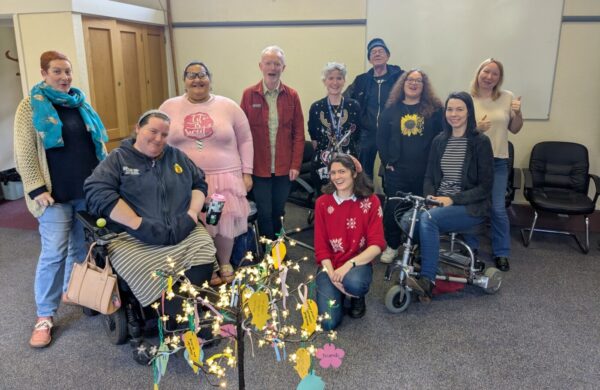
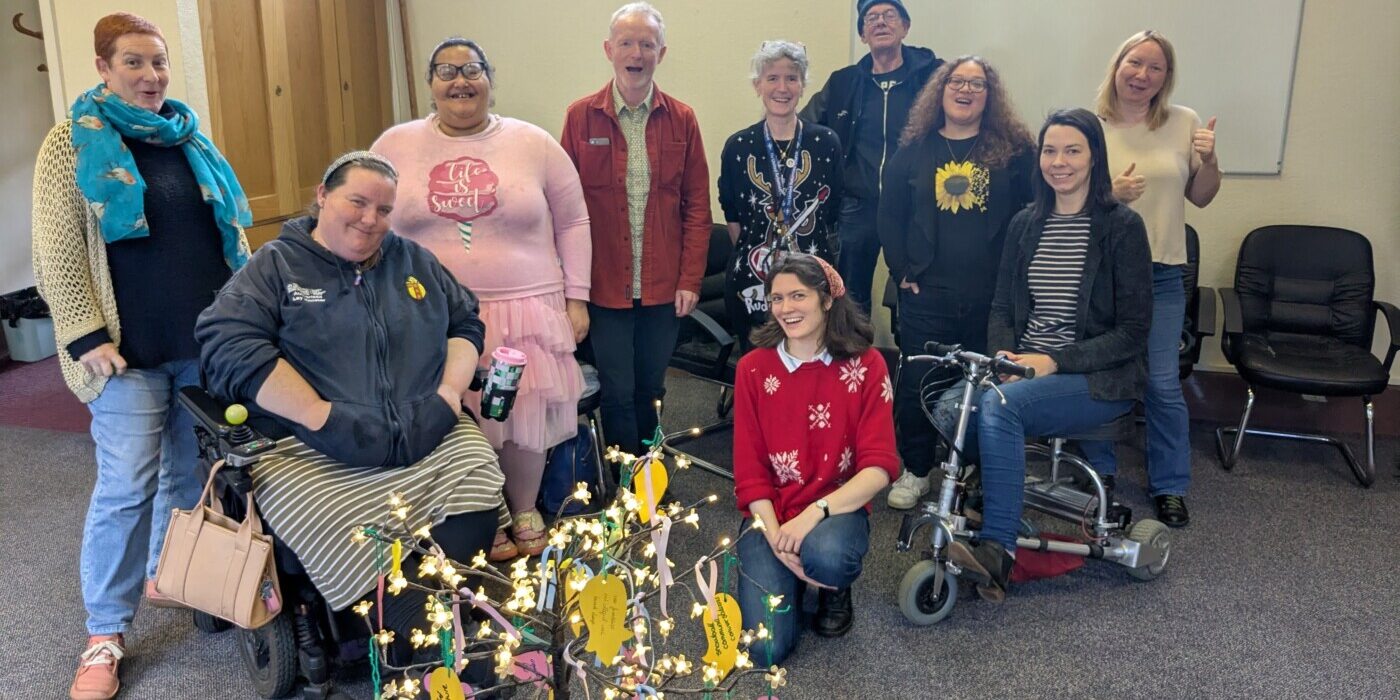
A group of people in a church hall, facing the camera, beside an artificial tree decorated with paper mesages.

That’s what we sought to find out, with a collaborative church project last year….

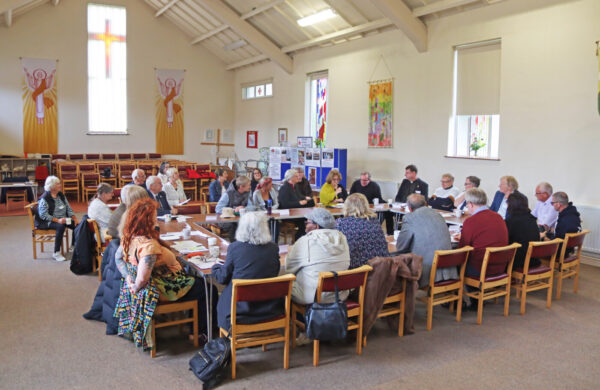
Sharing Power to Shape Mission was a series of intentional conversations aimed at bringing together people with lived experience of poverty in South Manchester, and local church leaders.

This earlier article outlined what we had in mind at the start of the project. So, a year on, how did it go?

We met regularly during 2025 to discuss experiences and ideas for tackling poverty and the church’s role.
The group included eight grassroots participants, who collectively had experience of disability, neurodiversity, racism, homelessness, depression, mental illness, abuse, the care system, the asylum system and stigmatisation.

Some were active in their churches, others had only limited interactions with church. Most had had some involvement in community projects that were run by or hosted in churches. There were also six church leaders, including URC ministers and a convenor, a theological college lecturer, and the chief execs of two Christian social justice charities.

We explored and unpacked the assumptions that exist about who is and isn’t part of the church, based on class and stigma, and how these assumptions can limit ideas about what people experiencing poverty can contribute. These assumptions are often made about other people, and can also be internalised and impact people’s dignity and self-worth. We discussed how to break down these assumptions and challenge the ‘middle class-ness’ of the church.

We also discussed different forms of power. We discovered that once assumptions were broken down there was more power within the group than might be expected, and this power was increased by coming together.

The aim of the project was to discern priorities for the church and to generate two or three practical ideas that the group could put into action. We discussed various ideas for carrying these discussions forward.

People felt there was a need for more ‘gritty conversations’ in which churches and communities genuinely listen to each other and are able to share hard truths. They want to reach out to churches and church leaders who are potentially interested in this sort of work but have not been prioritising it. The group also wants to explore ways to resource and support people with lived experience who have ideas for projects that tackle poverty and related social issues.

It remains to be seen how many of these ideas will come to fruition – but there is certainly lots of exciting potential.
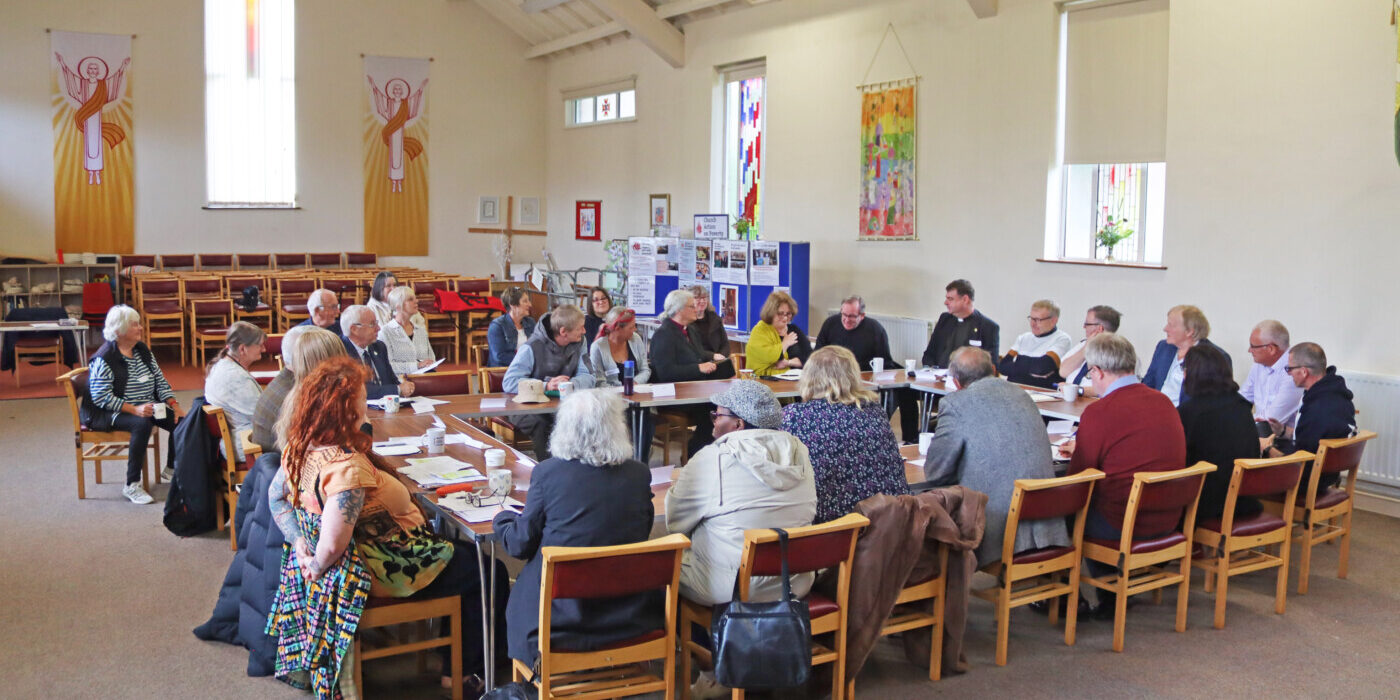
The 2026 AGM for Church Action on Poverty North East will be held on Wednesday 29 April.

It takes place at St Joseph’s Church, High Street West, Gateshead, NE8 1LX (next to the Interchange and Metro station). Parking is available.

The order of the evening is: 

5pm – food

5.30pm – AGM business

6pm – local voices

6.15pm – guest speaker, Dr Mwenza Blell, followed by Q&A

7.30pm – goodbye

Dr Blell’s talk is on the theme: Future challenges for the North East – Is there a role for faith communities? 

The AGM is an important moment in the year for Church Action on Poverty North East, reflecting on what has been achieved and looking ahead with hope.

Please notify Bernadette Askins (group chair) by April 20 if you plan to attend, to help with catering plans. You can text Bernadette on 07443 863738. 


News Resources

Food, faith & fellowship: 4 churches’ stories

Read four stories of churches nurturing faith and fellowship through food. St Cleopas, Dingle, Liverpool: “We find out a lot from people when they come” […]
News

The moral case and a 3-point plan for tax reform

Poverty is not inevitable – it is a choice we can change. Tom Burgess from Taxpayers Against Poverty outlines their new report.  For many churches […]
Opinion and insight

Synod is about to debate poverty. Here’s what we long to hear…

On Thursday (February 12), the Church of England General Synod debates a motion, “Poverty and the Church: 40 years after Faith In The City.” Our chief exec […]
News

How music and art helped churches grasp poverty

Art and music are great ways to bring people together for good – as The Let’s Face It! exhibition shows Churches in the South West […]
Opinion and insight

Why Christians can’t keep out of politics

This spring, Church Action on Poverty will support a course looking at combining theology and politics. James Butler of the Church Mission Society sets out […]
News Press Releases Resources

26 in 26: 200 churches register for social justice idea

Justice is integral to our faith. Church Action on Poverty and Christian Aid have teamed up to produce a new poster that your whole church […]

A collage of 3 photos. On the left: three people standing outside a church community building. Centre: Two cafe guests in very bright pink jackets. Right: two people sitting at a table, smiling at the camera.

Read four stories of churches nurturing faith and fellowship through food.

Church Action on Poverty Sunday: Food, faith & fellowship. 18 October 2026
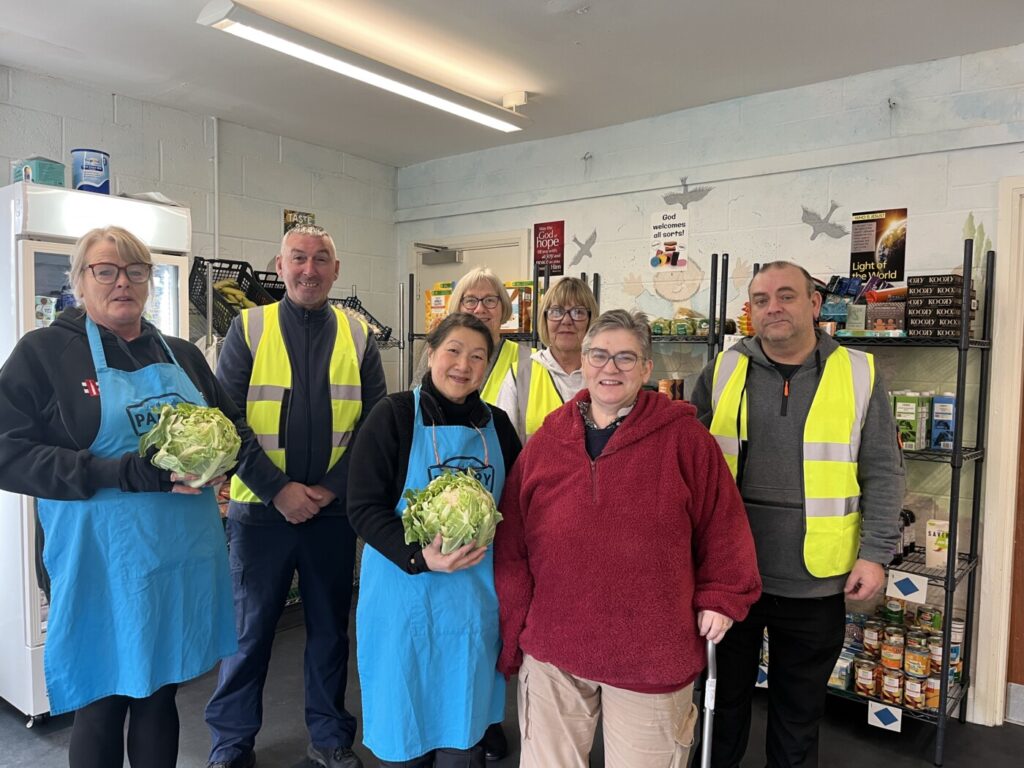
The team at Dingle Pantry. A woman in a red fleece stands with volunteers in blue aprons or high-vis jackets, in front of shelves of food.

St Cleopas, Dingle, Liverpool: "We find out a lot from people when they come"

“St Cleopas Church in Dingle, Liverpool, took part in Church Action on Poverty Sunday for the first time last year, using the materials to spark a discussion on local issues. 

Vicar, Siân Gasson said: “We like what Church Action on Poverty does, and that all the money goes to help people.”

The church, which is in one of the most economically deprived parishes in England,  runs a Your Local Pantry and a community cafe, so sees the way that food can bring a neighbourhood together to build fellowship and community, and to enable people to explore faith.

Siân (pictured above with Pantry volunteers) says: “We are here to serve the people of L8, Dingle, and this is one way in which we do that.

“Churches have to do this. Honestly, you have got to put people who are poor first, I think. We have been doing this for five years and people are coming all the time, and we find out a lot from people when they come.


"It changes our idea of what scripture means. I think every time I come here I will use something about it in the Sunday sermon if I can. I always want to do that."
A Bible
Siân Gasson
Vicar, St Cleopas in Dingle

“Personally, I have gone home some days and cried to God about certain people or situations. There’s always something that gets to you, but people are really upbeat as well. It is also fun at this place – the Liverpool sense of humour is brilliant!

“There is the verse, “She extends a helping hand to the poor and opens her arms to the needy.” (Proverbs 31:20).  I love this chapter, and I think that it’s a big part of what ministry is all about.

“And also: “Then a poor widow came and dropped in two small coins. Jesus called his disciples to him and said, “I tell you the truth, this poor widow has given more than all the others who are making contributions. For they gave a tiny part of their surplus, but she, poor as she is, has given everything she had to live on.”

“This was both a challenge and a comfort to me, personally. Over 20 years ago, my husband died, and it was the first time I thought about poverty for my children and myself. What is really special, is that it showed me that I still had a part to play, it didn’t matter that I was a widow, and Jesus could see that. So, this verse and the one in Proverbs remind you that God sees you, whoever you are.”


Seven people in dark blue aprons at London Emmanuel Pantry

Emmanuel Church, Maida Hill, London: "Our vision is not just to feed peoples bodies but to feed their souls and minds."

“In 2022, I had received many donations which were not easy to shift and we had lost the nursery that occupied our small hall.

“These two factors were important in the discussions to help local people experiencing food insecurity. Keith and I talked about maybe opening a food bank but Keith was very keen on the Pantry model, and the thought of giving people more dignity. The PCC was keen to give it a go with the hope that we would have enough volunteers. We launched in March 2023.

“It was slow at first but then it just mushroomed and we saw steady increases in numbers.

“We run the Pantry in both halls and the worship space is adjacent. Our vision is to get rid of the pews and have it as a flexible space, where people can be sitting around having refreshments, and we can offer wrap-around care. Our vision is not just to feed people’s bodies but to feed their souls and minds. 

“There’s not much crossover between people coming to church and coming to the Pantry – just a few. Quite a few Pantry members are Muslim, and quite a few go to different churches; eg we have many Eritrean members who attend an Eritrean Orthodox church not too far from here. But if there’s an event in their lives, and they live in the parish, we’re here to offer support, and it’s quite humbling that people ask for prayer.

“There are some people who live within easy walking distance and we would love to see them at services, events or the drop-in we run once in a while for a sense of something different in their lives. 

“This has brought a sense of purpose to the church as well. It’s a part of our missional vision to reach out to our community and serve our parish. Members are not coming to the Pantry because we are doing it for God; they’re coming for food – but that’s what we try to do. We do it with care and try to be personal with things, like making sure we provide for people who are vegetarian. We get to know people and their circumstances and people appreciate that thoughtfulness. Our vision is wrap-around care and signposting in a personal way. We try to be involved in people’s lives and earn their trust.”


A collage of 3 photos. On the left: three people standing outside a church community building. Centre: Two cafe guests in very bright pink jackets. Right: two people sitting at a table, smiling at the camera.

St Peter's, Norbiton: "The more we are here, the more we are building trust."

St Peter’s Norbiton is in South West London, a short walk from Kingston-Upon-Thames town centre.

As well as its main building, it has a small hall called Archway, about 7 minutes’ walk away, and it has run a community cafe there since 2021. The hall is on the edge of a big social housing estate, The Cambridge Road Estate, which is undergoing a lot of redevelopment. Over the next 15 years, all the buildings will be replaced with a mixture of social and private housing.

Natalie Jones, church curate, says: “It’s a real time of change and transition for a lot of residents. At the cafe, our objective is to feed people but also offer a listening space whereby we establish ongoing relationships, year in year out.

“A lot of people have known this building for a long time. We call it the parish hall, but it has the cafe, Tiny Tots, and youth groups and the council also uses it. We are positioned so well for engagement, which is exciting.

“The cafe runs from 10 to 12 on Wednesdays. As well as the food, through our partner church Doxa Deo and its City Changers charity, we can also offer debt advice, housing advice and links with GrowBaby. People can come for a cup of tea or a fuel voucher and then often stay for a chat. After the cafe, we invite people to stay for a short Bible study as well.

“We are on the cusp of 150 new neighbours. The buildings are shiny and glossy and moving is a nice feeling for people, but the circumstances going on in their lives do not necessarily become better.”

How ‘churchy’ is it? Who else uses the cafe?

“We have an open prayer meeting before we start the cafe. People know it’s run by St Peter’s Church and that there are Christians on the team. There are Bibles around for people to read and there’s a dedicated prayer table but prayer seems to be offered quite organically within our conversations with the guests.

“We have a person on the regeneration team who comes frequently, and the council staff stop by. There’s a community health and wellbeing worker who really sees the cafe as a helpful place to do her work from.

“We do eggs, sausage, bacon and some other stuff – it’s a bit of a mix: classic English breakfast, or yoghurt and granola and fruit. It’s all free but it’s like the loaves and fishes, we always seem to have enough. People often come for some element of the food, and get advice and support along the way.

“Most people don’t just come in then go back out. Because the food is right there, you can’t miss it. You have much longer conversations when you are there with a cup of tea.

"Our vision is that St Peter’s sees it as a way for us to engage, listen, and pray for the community. We know the needs that people have because of the cafe. It’s one of our key ways to meet with people, outside of a Sunday."
A Bible
Natalie Jones
Curate, St Peter's Norbiton

“It does feel like we are going out to the community – like in Luke 10, where Jesus sends out his disciples on mission – whilst also there’s a sense of us embedding Luke 14 too – and inviting people into the banquet.

“For us, it’s about understanding people’s needs. Such fruitful ministry happens when you are living and breathing the community. The more we are here, the more we are building trust.

What would you say to any churches starting out on work like this?

“Partnerships are key. We could have done the cafe and food and a warm space, and we would probably have got a few people coming in, but because we could connect with Doxa Deo and have other services, we have a USP which is such a privilege to offer.

“I would say if you have prayed and have a sense of God’s call – then go for it! But also see if there is another church that has something already happening, or has extra resources, and see how you can partner. Furthermore, seek to work well with the local authority. If you can build relationships here, it’s very helpful in the long run. Above all, listen for God’s voice and enjoy joining in with His kingdom work wherever He has called you!

Two pics: on the left, an outside shot of a church building; on the right a colourful and abundant table full of different foods.

Parson Cross, Sheffield: 18 languages uniting through food

Parson Cross Initiative (PXI) is a charity that runs from Mt Tabor Methodist Church in Sheffield. It hosts a wide range of activities throughout the week and across the year.

Pioneer minister Nick Waterfield says: “We’ve always seen food, faith and fellowship as sitting alongside each other, and around the table.

“From our lunchtime soups and sandwiches, to cooking on the community allotment, or community celebrations we share together, food is important. At its heart we see sharing food being about relationships and as a key to building social justice.

“Before the Covid pandemic we ran an independent food bank which helped a regular 100 households each week, during the pandemic we made a decision as Trustees to “come back different” and we did. We had worked alongside a Trussel foodbank during Covid and we left the foodbank business to them afterwards, turning instead to a more community pantry model of offering food for people, offering more agency and involvement from those accessing it.

“But we also have a history of eating and sharing together; whether that’s been soups cooked over an open fire on the allotments, or our meet and eat groups over the years (sometimes working with other partners like Foodcycle) or whether that’s been the community celebrations we’ve held to mark special times like Christmas.

“Most recently we shared a wonderful feast to celebrate Eid / Easter and Nowruz with our friends from SAVTE who run an English conversation class alongside us on a Tuesday. Over 18 languages are spoken in the group, which also consists of a variety of cultures and faiths.

“Food will always be an important part of what we offer, and at it’s heart is the desire to build fellowship and to share love, grace and hope”

Feeling inspired? Your church could support work like this, or start something where you are. Sign up now for Church Action on Poverty Sunday!

What happens when churches share power?

Church Action on Poverty North East AGM

Food, faith & fellowship: 4 churches’ stories

The moral case and a 3-point plan for tax reform

Synod is about to debate poverty. Here’s what we long to hear…

How music and art helped churches grasp poverty

Why Christians can’t keep out of politics

26 in 26: 200 churches register for social justice idea

Pilgrims call for more support in low-income neighbourhoods

How should churches address rural poverty?

Faith In The City: why it still matters, 40 years on

Pantries reach 1 million visits – as new research proves they work

Grief is hard enough: it’s time to improve funeral support

New toolkit: Hosting a regional anti-poverty roundtable

Review: The Perils of Universal Credit

Annual review 2024-25

On poverty and justice: A sermon and prayer for this week

New: The Autumn 2025 Spark newsletter

Prayer, care and action: how Christians should respond to injustice

The amazing 11-year-olds uniting a community through food

Make Them Pay: We’re backing the call for a just tax system

Glory: How I’m striving for change and a better society

Church Action on Poverty Sheffield: 2025 pilgrimage

Empty Plate Project lets local people be heard

We have a new Chief Exec – and we’ll continue to be a catalyst for change!

Are churches losing faith in low-income communities?

“The cuts are deeply immoral and should be opposed by all Christians”

SPARK newsletter summer 2025

Let’s End Poverty: what comes next?

Faith, justice & awesome activists: Niall reflects on his 28 years

A group of people in a church hall, facing the camera, beside an artificial tree decorated with paper mesages.

What happens when churches share power?

Church Action on Poverty North East AGM

A collage of 3 photos. On the left: three people standing outside a church community building. Centre: Two cafe guests in very bright pink jackets. Right: two people sitting at a table, smiling at the camera.

Food, faith & fellowship: 4 churches’ stories

The Taxpayers Against Poverty logo


Poverty is not inevitable – it is a choice we can change. Tom Burgess from Taxpayers Against Poverty outlines their new report. 

For many churches and faith communities, the reality of poverty is not abstract. It is visible in food banks, advice centres, community cafés and pastoral conversations.

It is seen in families juggling impossible choices, in children arriving at school hungry, and in people whose dignity is eroded by constant insecurity.

What is sometimes less visible is this: poverty in a wealthy country is not unavoidable. It is the result of choices — economic, political and moral — and that means it can be changed.

That is the central message of The Nicolson Report: The Poverty Scandal, published by Taxpayers Against Poverty (TAP) in the spirit of the late Reverend Paul Nicolson, the founder of TAP.

Paul believed that poverty should never be accepted as normal, and that public policy must be judged by its impact on the poorest. This report follows that conviction.

The Taxpayers Against Poverty logo

Poverty is harming the economy

The UK is one of the richest countries in the world, yet more than 14 million people live in poverty, including around 4.5 million children. Deep poverty and destitution are rising.

Many households cannot reliably afford food, heating or housing.

These are not marginal numbers. They represent a structural failure — and they come at a heavy cost, not just to individuals and families, but to society as a whole.

Poverty damages health, leading to avoidable illness and enormous pressure on the NHS. It undermines education and limits life chances. It weakens communities and erodes social trust. And it harms the economy through lost productivity and higher public spending.

The Nicolson Report estimates that poverty and hunger cost the UK economy over £75 billion every year in lost output and reactive spending. In other words, we already pay for poverty — just in the most destructive and inefficient way possible.

Preventing poverty is better than reacting to it

From a faith perspective, this matters deeply. Poverty is not just about material lack; it is about dignity, justice and relationship. When people are pushed into hardship by systems that fail them, something is broken in our common life.

But the report also makes a clear economic case: preventing poverty is far cheaper — and far more effective — than managing its consequences. Investing in people’s ability to live securely, participate in society and contribute to the economy benefits everyone.

This challenges a damaging narrative that has taken hold in recent years: that we cannot “afford” to reduce poverty. The evidence shows the opposite: we cannot afford not to.

Why tax reform matters

A key argument in the Nicolson Report is that the UK’s tax system actively contributes to poverty and inequality. At present, it over-taxes work and under-taxes wealth.

People on low and middle incomes pay income tax, National Insurance and VAT on most of what they spend. Meanwhile, large amounts of wealth — from property, investments
and inheritance — are taxed lightly, inconsistently or not at all.

Some of the poorest households pay a higher proportion of their income in tax than the wealthiest. This is not only unfair; it starves public services of the resources needed to prevent poverty.

The report argues for a shift towards fairer taxation of wealth, including:

  • Taxing income from wealth at similar rates to income from work
  • Reforming Council Tax so it reflects real property values and cancelling it for renters
  • Closing loopholes that allow large inheritances and investment income to escape fair taxation

These are not punitive measures. They are about responsibility and stewardship — recognising that wealth is built on shared foundations: education, healthcare, infrastructure and social stability.

A call to action

Churches have long understood that charity alone cannot end poverty. Compassion must be matched by justice. Alongside immediate support for those in need, we must also
challenge the systems that create and sustain hardship.

The Nicolson Report invites all of us — churches, campaigners, policymakers and citizens — to refuse to accept poverty as inevitable. It calls for bold leadership, fair taxation, and sustained investment in the things that allow everyone to flourish.

This is not about ideology. It is about outcomes. It is about choosing a society where no one is left behind.

Paul Nicolson believed that change begins when people refuse to look away. Faith communities across the country are already doing that work — standing alongside those in hardship, speaking truth to power, and holding hope alive.

The challenge now is to turn that moral clarity into structural change.Poverty benefits no one. Ending it benefits us all.

What happens when churches share power?

Church Action on Poverty North East AGM

Food, faith & fellowship: 4 churches’ stories

The moral case and a 3-point plan for tax reform

Synod is about to debate poverty. Here’s what we long to hear…

How music and art helped churches grasp poverty

Why Christians can’t keep out of politics

26 in 26: 200 churches register for social justice idea

Pilgrims call for more support in low-income neighbourhoods

How should churches address rural poverty?

Faith In The City: why it still matters, 40 years on

A group of people in a church hall, facing the camera, beside an artificial tree decorated with paper mesages.

What happens when churches share power?

Church Action on Poverty North East AGM

A collage of 3 photos. On the left: three people standing outside a church community building. Centre: Two cafe guests in very bright pink jackets. Right: two people sitting at a table, smiling at the camera.

Food, faith & fellowship: 4 churches’ stories

A woman stands beside a banner about homelessness, facing a mirror with words written on it.

Art and music are great ways to bring people together for good - as The Let's Face It! exhibition shows

Churches in the South West of England hosted an immersive art exhibition to improve people’s understanding of poverty and homelessness by sharing first-hand accounts.

More than 1,000 people visited the Let’s Face It! installation at Helston Central Methodist Church, Truro Methodist Church, The Mint Methodist church, The Royal Lyceum Theatre in Torquay, and Sherwell United Methodist Church in Plymouth.

Works included a rucksack filled with bricks with ‘cold’ and ‘hungry’ written on them, and a mirror adorned with labels, through which people were invited to view themselves.

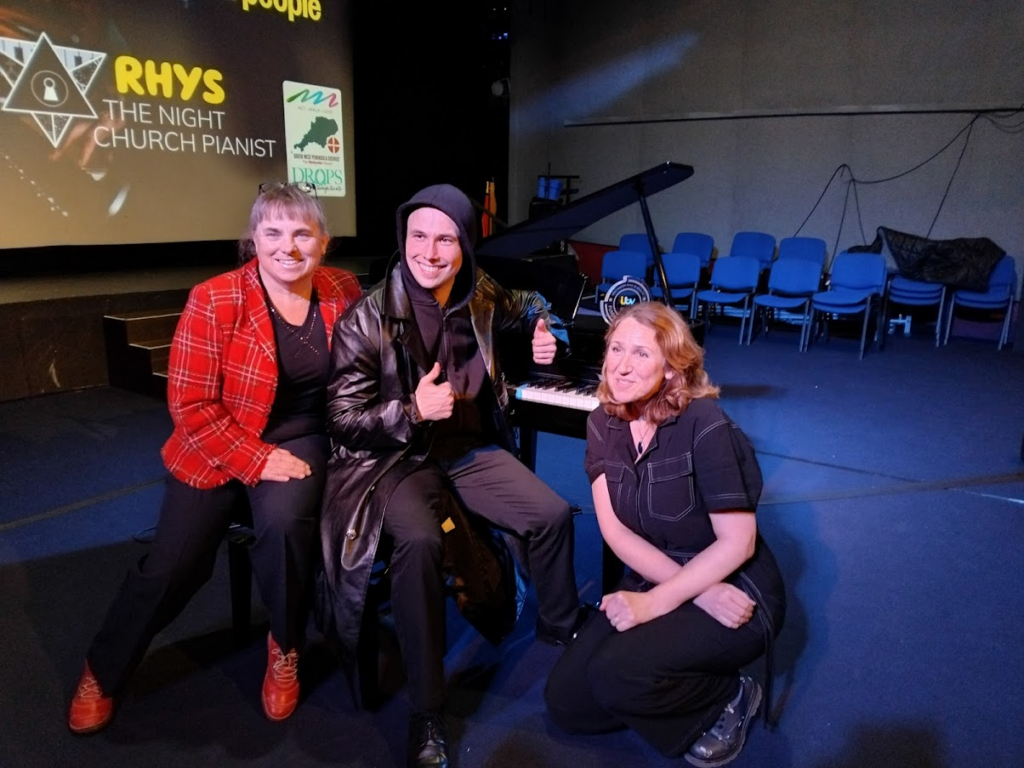
Organisers also used some of last year’s Church Action on Poverty Sunday resources, and there was live music and testimony by Rhys Wynne-Jones, ‘the nightchurch pianist’, who shared his experience of homelessness.

In the video of the exhibition (above), Rhys says: “Something that homeless people need more than a home is to heal and to be understood, so this art exhibition is vital to have that link between society and people who are homeless.”

Helen Pearce, social justice coordinator for the South West Peninsula Methodist District, said the Let’s Face It! tour drew a positive response and insightful ideas.

She said: “Good news stories are always encouraging. This is certainly that. The whole initiative was supported by prayer an we saw many amazing answers in how it came together and how it was received.”

One visitor said: “I was just blown away by all of it. Humbling is the right word. What Rhys said was so profound and heartfelt – and what a talent!”

The Let’s Face It! organisers have kindly given a share of the money donated at the events to Church Action on Poverty, to support our ongoing work.

The exhibition has been designed for easy transportation and to be used in other spaces. If churches from other areas are interested in the exhibition coming to them, please contact Helen Pearce on socialjustice@swpmethodist.org.uk or 07450 989571.

A posed shot of three people sitting in a hall
  • The exhibition was made possible through a seed corn grant from the South West Peninsula Methodist District and a grant from the Susanna Wesley Foundation. 
A headshot of man in a woollen hat, with "Let's Face It" written alongside

What happens when churches share power?

Church Action on Poverty North East AGM

Food, faith & fellowship: 4 churches’ stories

The moral case and a 3-point plan for tax reform

Synod is about to debate poverty. Here’s what we long to hear…

How music and art helped churches grasp poverty

Why Christians can’t keep out of politics

26 in 26: 200 churches register for social justice idea

A group of people in a church hall, facing the camera, beside an artificial tree decorated with paper mesages.

What happens when churches share power?

Church Action on Poverty North East AGM

A collage of 3 photos. On the left: three people standing outside a church community building. Centre: Two cafe guests in very bright pink jackets. Right: two people sitting at a table, smiling at the camera.

Food, faith & fellowship: 4 churches’ stories

A Bible

This spring, Church Action on Poverty will support a course looking at combining theology and politics. James Butler of the Church Mission Society sets out why engaging with politics is a key aspect of the Christian faith. 
When Christians speak out about the big issues and challenges of the day, they are often met with the comment: “Churches should keep out of politics.”  

Faith in Public: Political Theology for Mission, a three day, residential event, argues the opposite: churches and Christian organisations must engage in the big issues of our day in public ways. It’s part of our faithful witness and we have something important to offer these conversations. 

Wondering what this looks like in practice? If you are a Christian working in a public role, involved in a church or organisation seeking to engage with society, or interested in exploring what it means to witness to Christ in public, then this course is for you.

Introducing the Faith In Public course

The event will take place in May in Manchester, which has a long history of being at the cutting edge of politics and social justice in the UK. It will provide the opportunity to spend time with churches, organisations and people living faith in public.
  • Grace Thomas, Canon Missioner at Manchester Cathedral and Environment Officer for Manchester Diocese, will explore how the Cathedral has been a place of public witness over the centuries.
  • Ian Rutherford, City Centre Minister at Methodist Central Hall Manchester, will help delegates explore how faith is lived in public today.
  • Dominic Budhi-Thornton, a public theologian, and James Butler, Church Mission Society Pioneer Mission Training leader, will delve deeper into the biblical and theological roots of such engagement.
  • Jane Perry, from Church Action on Poverty, will discuss the importance of hearing from people with lived experience of poverty, and outline practical ways to ensure they are fully included in church-led political engagement.
Delegates will also meet a number of people working in public roles, including politicians, civil servants and leaders of organisations, to discuss how they navigate their work through their faith.
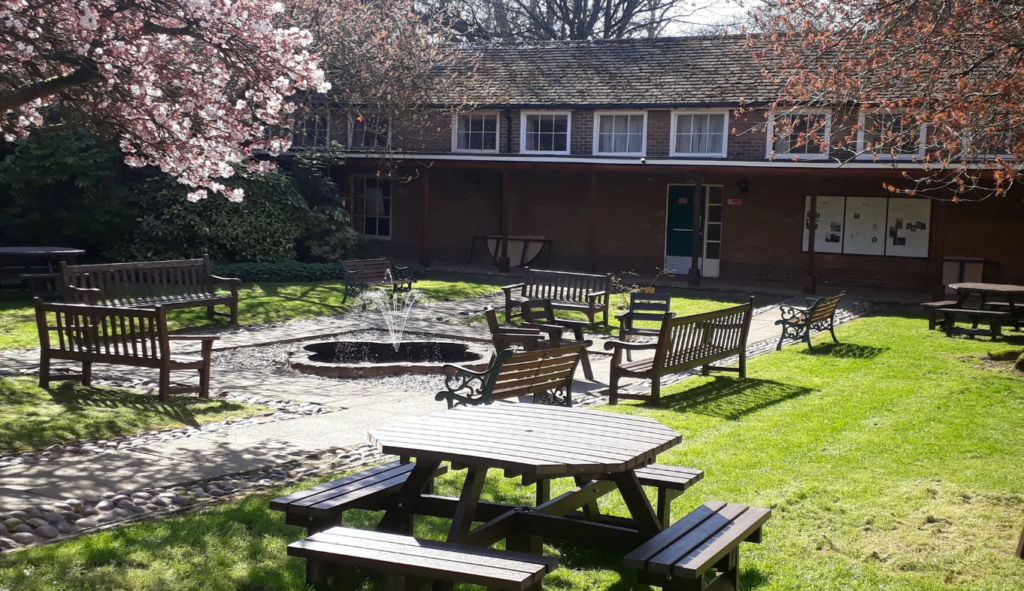
Wooden tables and benches in a garden courtyard
The course takes place at Luther King House in Manchester

What previous Faith In Public participants said

Church Mission Society Pioneer Mission Training ran a similar course in London last year. Reflecting on the experience Jo, a vicar and leader of a mission-focused charity, said:

“This course offered a rare moment when politics was not only allowed at the dinner table but welcomed, which I hugely enjoyed. One of the great joys was seeing people who clearly love Jesus already living this out in their communities and having the opportunity to learn from their experience. I’d recommend it to anyone who wants to think deeply about local politics and discover new ways to put mission into practice.”
Jo

Philip, who works for a charity around justice, commented:

“Is it possible to be political and missional at the same time? Well, this is exactly what this programme was all about. It enabled me to deepen my understanding on how I can serve in God’s mission by becoming politically aware and engaged. This programme was also hands-on and practical. And I came away with a sense that I am connected to a wider community of practitioners of justice.”
Philip

Background to the Faith In Public course

When teaching on mission I realised that there were a whole range of issues people were facing and questions that people had which had long been reflected on by Christians under the names of political theology and public theology. 

In this course we bring together mission studies and the insights from political and public theology to explore how to live faith in public.

By understanding how historically people have understood the relationship between church and state, and how churches and Christians have navigated public life, we will help people to draw out new ways of thinking, new resources and fresh practices to live faith in public.

Sign up

Take part Faith in Public: Political Theology for Mission takes place from Thursday 7 to Saturday 9 May 2026. Accommodation and some teaching will take place at Luther King House, with additional travel into Manchester City Centre to visit relevant projects and venues.

Get involved

Book your place

What happens when churches share power?

Church Action on Poverty North East AGM

Food, faith & fellowship: 4 churches’ stories

The moral case and a 3-point plan for tax reform

Synod is about to debate poverty. Here’s what we long to hear…

How music and art helped churches grasp poverty

Why Christians can’t keep out of politics

26 in 26: 200 churches register for social justice idea

Pilgrims call for more support in low-income neighbourhoods

How should churches address rural poverty?

Faith In The City: why it still matters, 40 years on

Pantries reach 1 million visits – as new research proves they work

Grief is hard enough: it’s time to improve funeral support

New toolkit: Hosting a regional anti-poverty roundtable

A group of people in a church hall, facing the camera, beside an artificial tree decorated with paper mesages.

What happens when churches share power?

Church Action on Poverty North East AGM

A collage of 3 photos. On the left: three people standing outside a church community building. Centre: Two cafe guests in very bright pink jackets. Right: two people sitting at a table, smiling at the camera.

Food, faith & fellowship: 4 churches’ stories

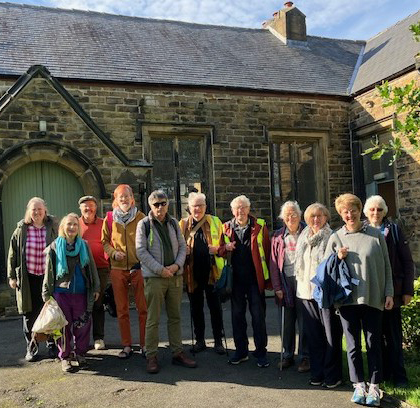
A group of 11 people standing in front of a church building

Bob Rae reports on Sheffield Church Action on Poverty's annual pilgrimage

Anti-poverty campaigners in the Sheffield neighbourhoods of Firvale, Wincobank and Firth Park are calling for major improvement in the help provided for people struggling to find work, and for free face-to-face advice for people forced to rely on food banks.

The calls came during an Urban Poverty Pilgrimage marking the 25th anniversary of the founding of Sheffield Church Action on Poverty.

Speaking in Firth Park Methodist Church, at the end of the event, Jayne Franklin, from the S6 Foodbank, told pilgrims people wanted to work, but found searching for a job daunting and needed additional help.

Calling for free, face to face advice services to be provided for food bank users, she said some food bank users were isolated and marginalised and had complex problems. Sometimes they did not even realise they were in debt.

They desperately needed help, but some essential advice services were no longer available face to face and users faced costs for accessing services that they could ill-afford.

A group of 11 people standing in front of a church building

The annual Sheffield CAP Pilgrimage is designed to raise awareness and understanding of how poverty is affecting people in Sheffield and the initiatives to fight it.

This year, the pilgrimage traversed an area of Sheffield which is ethnically very diverse, including people originally from Pakistan, Nigeria and other parts of the world beyond Europe who settled in the 20th century to be followed by members of the Roma community who had suffered extreme deprivation in Slovakia.

Throughout the area, family groupings tend to be large, the level of qualifications can be low and research shows a third of children are living in poverty,

Although the area has suffered from car crime and litter problems there is a real sense of community and people do not feel nervous walking in the streets in the evening.

The Pilgrimage passed the sites of no fewer than three Foodbanks, including the Firvale Food bank, which operates out of St Cuthbert’s Church, where the Pilgrimage began.

They heard that the S6 Food Bank was founded 15 years ago and had only three sites before the Covid pandemic. Since then, growing need has resulted in it expanding to a dozen sites from which it distributes a ton of food a week to support local people, one third of whom are children.

After visiting Firvale Community Hub, pilgrims praised the work of the Sheffield City Council-backed hubs, which, in Firvale’s case, provides education, employment, health, culture and immigration serves, as well as support for pregnant women.

Among the other sites the pilgrims visited was Upper Wincobank Undenenominational Church, built in as a school by Mary Ann Rawson, who, after her husband died, devoted herself to anti-slavery and educational activities, networking with many other campaigners in the UK and overseas.

Sheffield CAP chair, Dr Joe Forde, who recently co-authored a book examining the impact of the Church of England’s Faith in the City anti-inequality initiative, said: “This year’s pilgrimage took us past hospitals, schools and housing estates which are all dealing with people feeling the impact of poverty in one way or another.

“The lack of face-to-face support services for people suffering poverty and the rise in demand for foodbanks is an indictment of our country.

“They would be less necessary if the Government could remove the social security cuts imposed by the previous Government, including the two child limit and the benefit cap.

What happens when churches share power?

Church Action on Poverty North East AGM

Food, faith & fellowship: 4 churches’ stories

The moral case and a 3-point plan for tax reform

Synod is about to debate poverty. Here’s what we long to hear…

How music and art helped churches grasp poverty

Why Christians can’t keep out of politics

26 in 26: 200 churches register for social justice idea

Pilgrims call for more support in low-income neighbourhoods

A group of people in a church hall, facing the camera, beside an artificial tree decorated with paper mesages.

What happens when churches share power?

Church Action on Poverty North East AGM

A collage of 3 photos. On the left: three people standing outside a church community building. Centre: Two cafe guests in very bright pink jackets. Right: two people sitting at a table, smiling at the camera.

Food, faith & fellowship: 4 churches’ stories

The top section of a book cover, reading Celebrating Forty Years of Faith In The City

In a new book, authors Terry Drummond and Joseph Forde revisit the landmark Faith In The City report, 40 years on.

Faith in the City, published in the autumn of 1985, was a
report that resonated with many congregants in the Church of
England, and is still regarded as being a landmark publication
in post-war Church – State relations.

It was a report that had been commissioned by Archbishop Robert Runcie out of a concern – widely held within the clergy – that the economic and social polices being pursued by Mrs Thatcher’s government were having a damaging impact on inner-city communities, and had contributed to the cause of the riots that had broken out in several English cities in 1981.

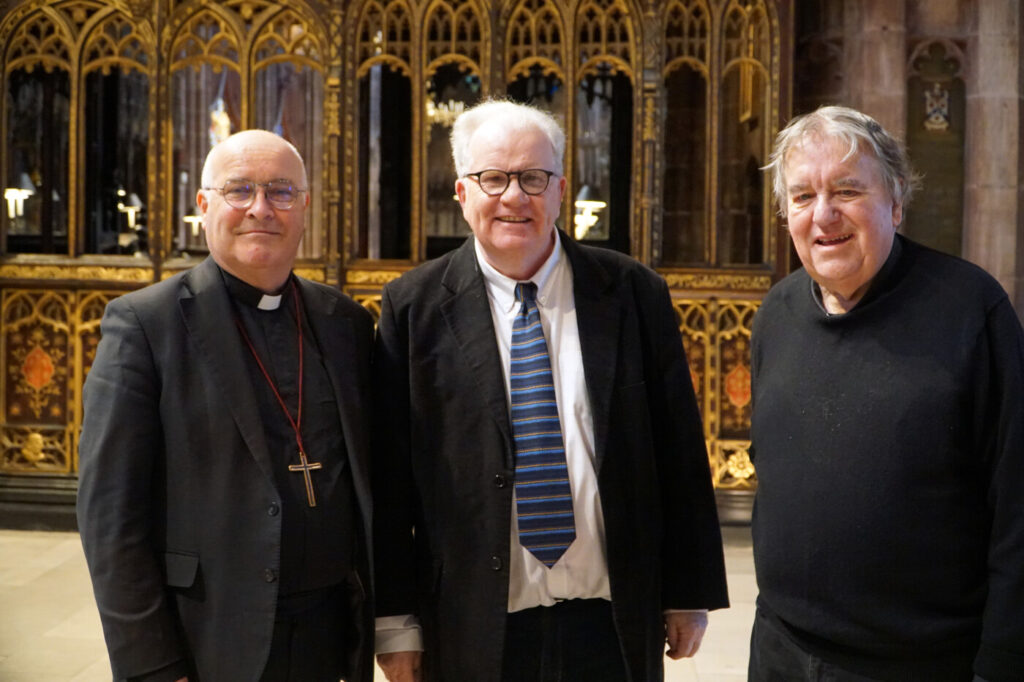
Three men standing in Manchester Cathedral: The Archbishop of York, and authors Joseph Forde and Terry Drummond.

The original report drew a huge response

Forty years on, it is difficult to think of any publication from
within the Church of England that has received the level of
intellectual and political hostility that it encountered from
some government ministers, including the Prime Minister,
Margaret Thatcher.

This resulted in it having only a limited impact on changing government economic and social policy. However, we believe that there is still a need for us to remember and reflect on the report, not least because it spoke truth to power.

It did that by challenging the government of the day to rethink its approach in policy areas it believed were adversely affecting urban communities in cities and towns up and down the country, including in its approach to poverty alleviation and welfare provision.

Why we commissioned & edited the new book

It was with this purpose in mind that we decided to commission an essay collection written by some of those who were involved in the publication and implementation of the report itself, and others who have been engaged in urban mission and ministry since. The book is called Celebrating Forty Years of Faith in the City, and is published by Sacristy Press.

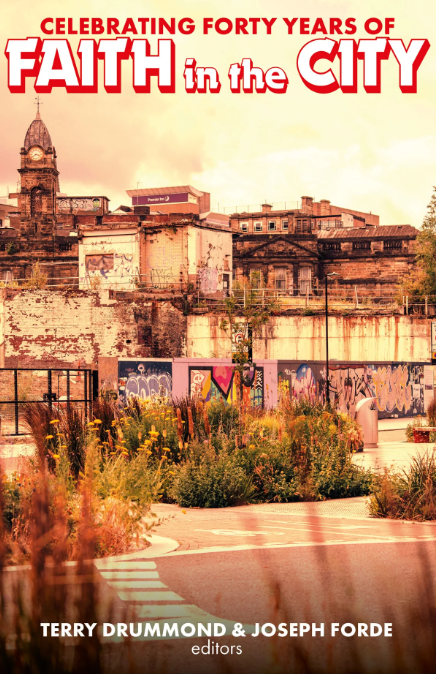
A book cover, reading Celebrating Forty Years of Faith In The City

Faith In The City revisited

This collection of essays examines:

  • the impact that the report had at the time of its publication
  • the changes that have taken place in the political landscape in the period since
  • the changes that have taken place in English society in the period since, and
  • the changes that have taken place in the Church of England, including in its approach to urban mission, ministry, and welfare provision.

The result is a book that underscores the importance of the Church’s commitment to local communities, particularly in urban priority areas.

We think that a recovery of the report’s radical challenge rooted in incarnational theology and the strong links between Church, Faith and Society is the best way of ensuring that the Church of England remains connected to urban communities and encourages a new commitment to urban mission and ministry.

Celebrating Faith In The City: launch events

Recently, we were delighted to be interviewed about the book
by the Right Revd Stephen Cottrell, Archbishop of York, at a joint event organised by Greater Together Manchester and
the Church Urban Fund, and held at Manchester Cathedral on 14th November (see photo at the top of this blog).

We also spoke at an event at St Mary’s Church in Portsmouth on 20th November.

We hope that 2025 will be a time to celebrate all that is good
about urban mission and ministry today in the Church of England (and other Churches, too) as we celebrate its 40th anniversary, as well as to reflect on any lessons that we can take from Faith in the City and the impact it had, then and since, on shaping our understanding of urban theology, mission and ministry for today.

What happens when churches share power?

Church Action on Poverty North East AGM

Food, faith & fellowship: 4 churches’ stories

The moral case and a 3-point plan for tax reform

Synod is about to debate poverty. Here’s what we long to hear…

How music and art helped churches grasp poverty

Why Christians can’t keep out of politics

26 in 26: 200 churches register for social justice idea

Pilgrims call for more support in low-income neighbourhoods

How should churches address rural poverty?

Faith In The City: why it still matters, 40 years on

A group of people in a church hall, facing the camera, beside an artificial tree decorated with paper mesages.

What happens when churches share power?

Church Action on Poverty North East AGM

A collage of 3 photos. On the left: three people standing outside a church community building. Centre: Two cafe guests in very bright pink jackets. Right: two people sitting at a table, smiling at the camera.

Food, faith & fellowship: 4 churches’ stories

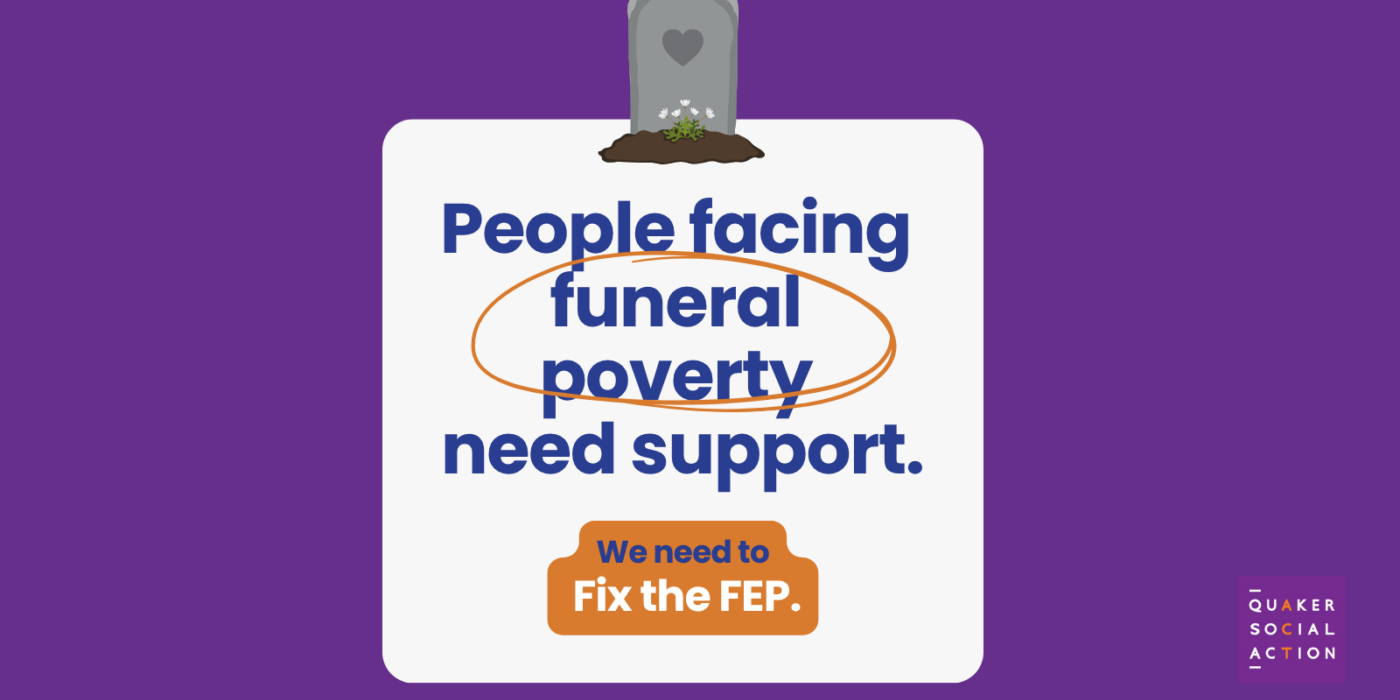
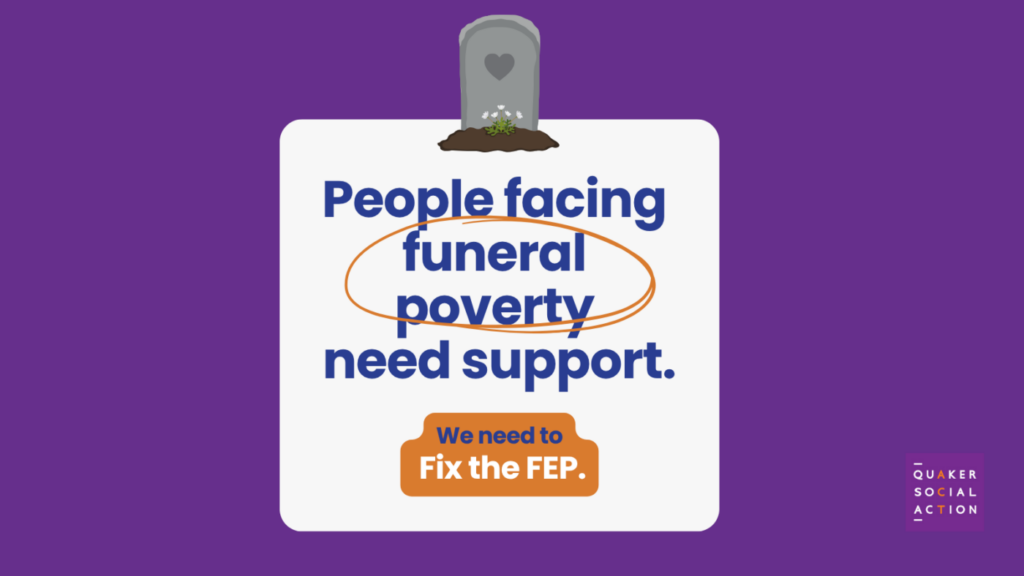
A graphic reading "People facing funeral poverty need support".

Lindesay Mace from Quaker Social Action outlines their latest work to help people with funeral costs

A graphic reading "People facing funeral poverty need support".

Bereavement can be a deeply challenging experience. In the last three years, two people close to me have died, both quite suddenly, and the impact was profound. I experienced brain fog; difficulties concentrating at work; sudden floods of tears in the street; a loss of appetite; difficulty sleeping; and feelings of anger and guilt.

It was tough, but it could have been so much worse. I wasn’t responsible for organising the funerals, nor did I have to manage that while worrying about how on earth I would pay for them. 

But thousands of people across the UK are in that position every year and at Down to Earth, the only UK-wide funeral costs support service, we hear their heartbreaking stories every day.

Two of these stories, bravely shared on video by our clients Sue and Susan, are at the heart of our new campaign, Grief is Hard Enough: Fix the FEP.

Soaring costs and an inadequate safety net

“You’d think that in your darkest, most desperate hour that there’d be somebody there to help you”.
Sue

It’s not uncommon for a funeral with mourners present to cost upwards of £4,000 – but what if you don’t have the funds? Even the simplest option, a direct cremation that takes place with no mourners present, generally costs between £1,000 and £2,000. 

That is a sum far out of reach for thousands of people. The Funeral Expenses Payment (FEP) provides vital financial support with funeral costs and is aimed at people in England and Wales who are in receipt of a “qualifying benefit” (any income-related benefit like Universal Credit). However, the eligibility rules are very narrow and don’t reflect real life, leaving thousands of people who are receiving a qualifying benefit without this help and struggling with funeral costs.

People are going deep into debt and cutting back on essentials like food – all to try to afford a funeral for their family member or friend.

It doesn't have to be this way - take action with us

In 2017, the Scottish Government committed to tackling funeral poverty and it has taken some significant steps forward. Scotland’s Funeral Support Payment, introduced in 2019, takes a more flexible, compassionate approach and it’s estimated that 40% more people can access it compared to the FEP.

Our campaign Grief is Hard Enough: Fix the FEP calls on the Government to align the FEP criteria with Scotland’s payment and, to build pressure, we are calling on the public to write to their MPs about it.

The campaign, launched at the start of November, has had a brilliant start: we are already in double figures for people taking action and we also know of two supporters who have had responses from their MPs, one of whom has offered a meeting.

Help us keep up the momentum by visiting our campaign page for full details of how to write to your MP.

Grief is hard enough: It’s time to Fix the FEP.

Lindesay Mace is co-manager of Down to Earth, a project run by anti-poverty charity Quaker Social Action. It is the only UK-wide project that works to ensure everyone has access to an affordable, meaningful funeral. Thousands of people each year
access our large suite of online resources on reducing funeral costs and raising funds towards them, and our national helpline assists hundreds of people a year who need tailored support.

Church Action on Poverty worked with Quaker Social Action and others on this issue some years ago. See more on our previous work here

What happens when churches share power?

Church Action on Poverty North East AGM

Food, faith & fellowship: 4 churches’ stories

The moral case and a 3-point plan for tax reform

Synod is about to debate poverty. Here’s what we long to hear…

How music and art helped churches grasp poverty

Why Christians can’t keep out of politics

26 in 26: 200 churches register for social justice idea

Pilgrims call for more support in low-income neighbourhoods

How should churches address rural poverty?

Faith In The City: why it still matters, 40 years on

A group of people in a church hall, facing the camera, beside an artificial tree decorated with paper mesages.

What happens when churches share power?

Church Action on Poverty North East AGM

A collage of 3 photos. On the left: three people standing outside a church community building. Centre: Two cafe guests in very bright pink jackets. Right: two people sitting at a table, smiling at the camera.

Food, faith & fellowship: 4 churches’ stories

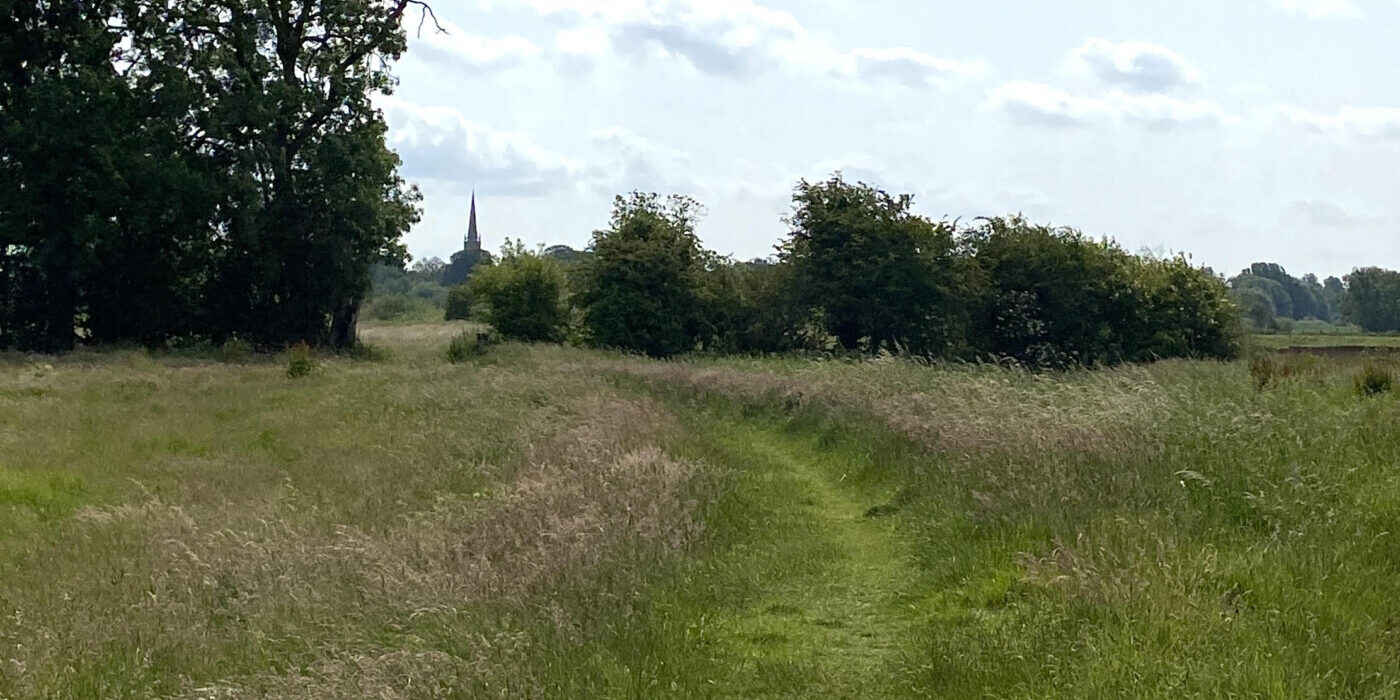
A gentle path through a field in the foreground, with a church steeple in the distance among some trees.

How is rural poverty changing, and how should churches, dioceses and Government respond? Paul Phillips explores the issue, and reports on his diocese’s work.
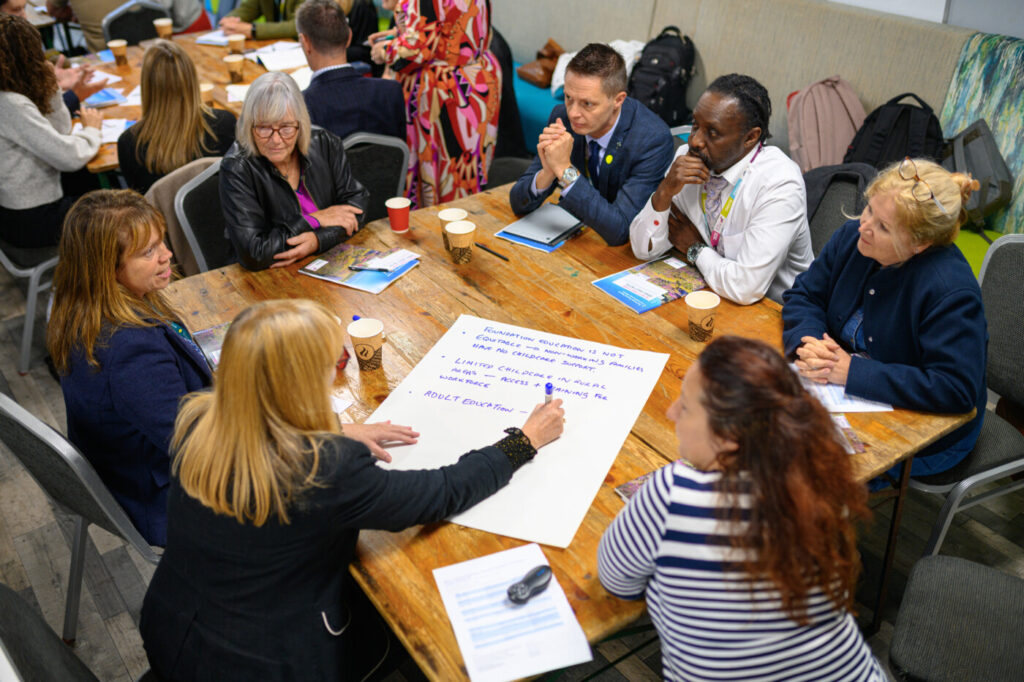
In September 2025, an academic report was published and launched in St. Dennis, a small village of around 3,000 people in rural Cornwall. The venue was the local football club hospitality building, overlooked by rolling green hills dotted with sheep and the recycling and recovery centre incinerator towers. Perhaps not the most impressive setting, but certainly a relevant one.

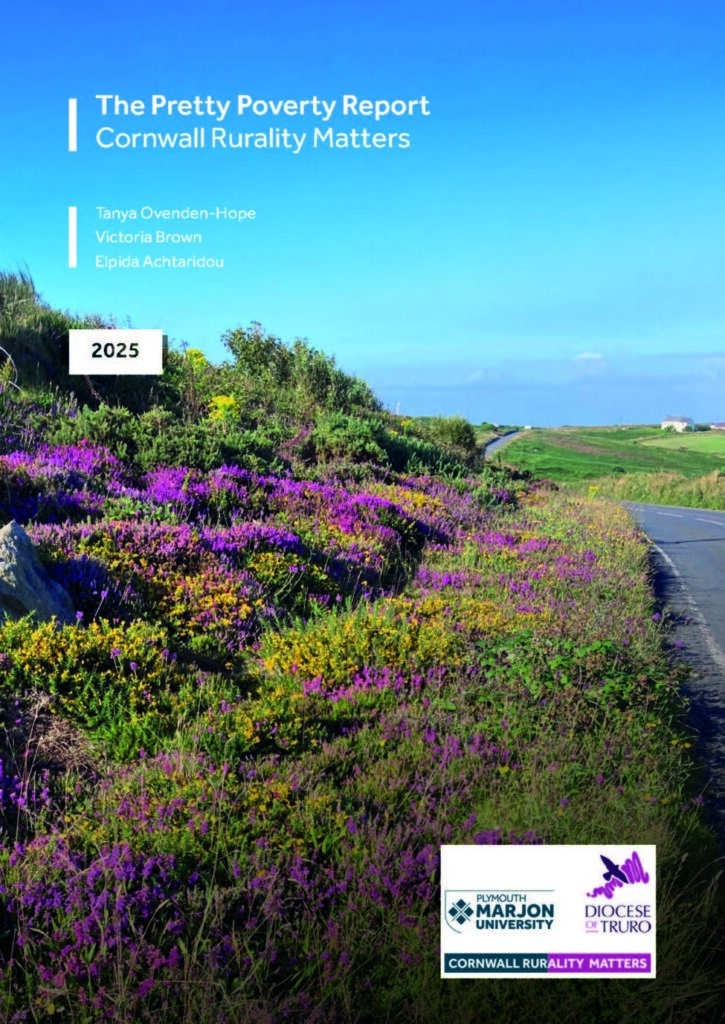
The report, called Pretty Poverty: Cornwall Rurality Matters, was commissioned by the Diocese of Truro and supported and carried out by Plymouth Marjon University. It shines a light on how the IMD (Index of Multiple Deprivation), the government’s standard measure of poverty, is inadequately representing poverty in rural contexts, particularly Cornwall.

The cover of the Pretty Poverty report: a colourful rural scene, with purple flowers in the foreground

Rural poverty: pockets of hardship are hidden

Due to the size of the areas the country is broken down into, the IMD masks pockets of hardship which get averaged out by nearby areas of affluence. 

Misunderstanding the importance of a car in rural areas is also a glaring error in the Government data – it is not a sign of wealth or a luxury but an essential tool to enable people to travel around rural areas without having to depend on shaky (or non-existent) public transport or the kindness and availability of friends and family. Owning a car (with road tax, insurance, and general upkeep costs) imposes a ‘rural tax’ on people who live outside of cities and larger towns.

For those of us who live and work in these areas, there isn’t a lot of ‘new news’, but the importance of having a scientifically researched academic paper which gives credence to all our anecdotal, lived experiences is so important.

Rural poverty: a funding shift is needed

Perran Moon, MP for Camborne and Redruth, wrote in his foreword for the report, “I have said it before, and it bears repeating: there is no single, sweeping reform – no matter how radical – that can reset the pressures that Cornwall faces. But a crucial first step, as this report outlines, is to ensure that funding distribution reflects the unique characteristics of remote coastal areas like ours.’.

People sitting at tables, with one person writing on a large flip-chart sheet on the table
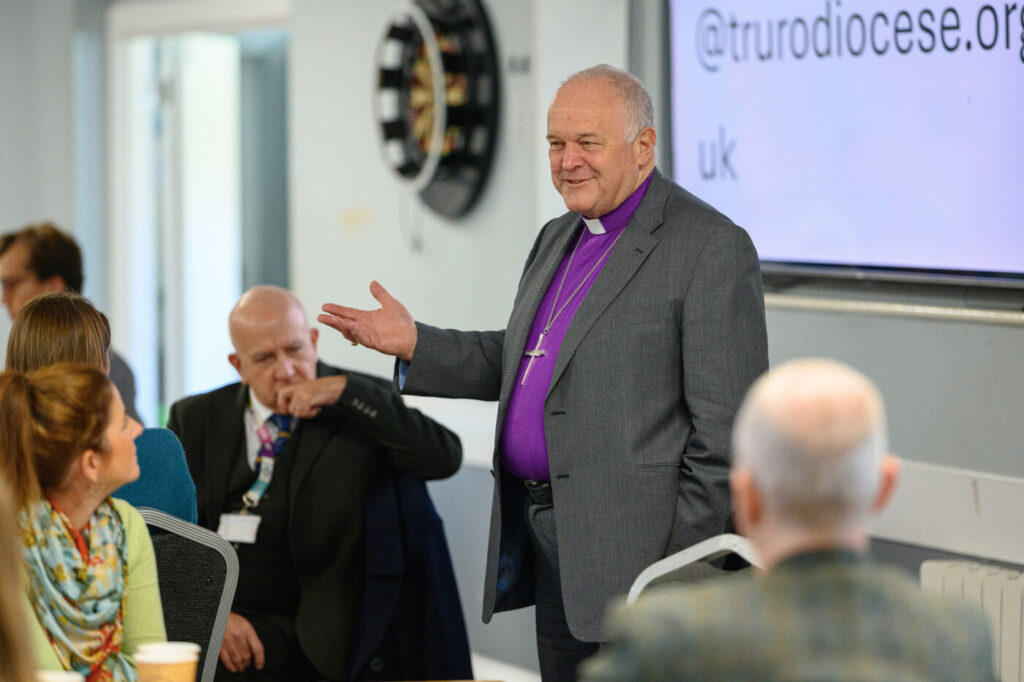
A clergyman in a purple shirt is standing speaking in a meeting room, with other people sitting at tables
The Rt Rev David Williams, Bishop of Truro, speaks at the launch of Pretty Poverty. Picture by PR4Photos.

Rural poverty: church at the forefront

The Rt Revd David Williams, Bishop of Truro (pictured above), said: “The church here has always looked beyond the pretty views, and beyond our well-placed pride in Cornwall, and understood what lies deeper. That’s why the church is at the forefront of work through foodbanks, debt advice, crisis support, education, and a thousand other ways to be Good News for those most in need.”.

What does it mean for Cornwall - and other rural communities?

But what does this mean for Cornwall?

As a Diocese, we are already having conversations about how the outcomes of this will affect the work we do and how we do it. How might you and your organisation or church take the outcomes of Pretty Poverty and look at your context differently? What changes might need to be made in your local area to make a deep impact to those in need?

This research, focussed on six areas in Cornwall, is not just for Cornwall, however. Our hope and prayer is that the government takes notice of this report and changes the way they measure deprivation in rural areas across the country.

Do spend some time reading the report and use what connections you have to share it with your local MP and local leaders.

Paul Phillips is social responsibility officer at the Diocese of Truro. If you would be interested in potentially joining in wider discussions about church responses to rural poverty, email Gavin on our staff team.

What happens when churches share power?

Church Action on Poverty North East AGM

Food, faith & fellowship: 4 churches’ stories

The moral case and a 3-point plan for tax reform

Synod is about to debate poverty. Here’s what we long to hear…

How music and art helped churches grasp poverty

Why Christians can’t keep out of politics

26 in 26: 200 churches register for social justice idea

Pilgrims call for more support in low-income neighbourhoods

How should churches address rural poverty?

Faith In The City: why it still matters, 40 years on

Pantries reach 1 million visits – as new research proves they work

Grief is hard enough: it’s time to improve funeral support

A group of people in a church hall, facing the camera, beside an artificial tree decorated with paper mesages.

What happens when churches share power?

Church Action on Poverty North East AGM

A collage of 3 photos. On the left: three people standing outside a church community building. Centre: Two cafe guests in very bright pink jackets. Right: two people sitting at a table, smiling at the camera.

Food, faith & fellowship: 4 churches’ stories