fbpx
The Taxpayers Against Poverty logo


Poverty is not inevitable – it is a choice we can change. Tom Burgess from Taxpayers Against Poverty outlines their new report. 

For many churches and faith communities, the reality of poverty is not abstract. It is visible in food banks, advice centres, community cafés and pastoral conversations.

It is seen in families juggling impossible choices, in children arriving at school hungry, and in people whose dignity is eroded by constant insecurity.

What is sometimes less visible is this: poverty in a wealthy country is not unavoidable. It is the result of choices — economic, political and moral — and that means it can be changed.

That is the central message of The Nicolson Report: The Poverty Scandal, published by Taxpayers Against Poverty (TAP) in the spirit of the late Reverend Paul Nicolson, the founder of TAP.

Paul believed that poverty should never be accepted as normal, and that public policy must be judged by its impact on the poorest. This report follows that conviction.

The Taxpayers Against Poverty logo

Poverty is harming the economy

The UK is one of the richest countries in the world, yet more than 14 million people live in poverty, including around 4.5 million children. Deep poverty and destitution are rising.

Many households cannot reliably afford food, heating or housing.

These are not marginal numbers. They represent a structural failure — and they come at a heavy cost, not just to individuals and families, but to society as a whole.

Poverty damages health, leading to avoidable illness and enormous pressure on the NHS. It undermines education and limits life chances. It weakens communities and erodes social trust. And it harms the economy through lost productivity and higher public spending.

The Nicolson Report estimates that poverty and hunger cost the UK economy over £75 billion every year in lost output and reactive spending. In other words, we already pay for poverty — just in the most destructive and inefficient way possible.

Preventing poverty is better than reacting to it

From a faith perspective, this matters deeply. Poverty is not just about material lack; it is about dignity, justice and relationship. When people are pushed into hardship by systems that fail them, something is broken in our common life.

But the report also makes a clear economic case: preventing poverty is far cheaper — and far more effective — than managing its consequences. Investing in people’s ability to live securely, participate in society and contribute to the economy benefits everyone.

This challenges a damaging narrative that has taken hold in recent years: that we cannot “afford” to reduce poverty. The evidence shows the opposite: we cannot afford not to.

Why tax reform matters

A key argument in the Nicolson Report is that the UK’s tax system actively contributes to poverty and inequality. At present, it over-taxes work and under-taxes wealth.

People on low and middle incomes pay income tax, National Insurance and VAT on most of what they spend. Meanwhile, large amounts of wealth — from property, investments
and inheritance — are taxed lightly, inconsistently or not at all.

Some of the poorest households pay a higher proportion of their income in tax than the wealthiest. This is not only unfair; it starves public services of the resources needed to prevent poverty.

The report argues for a shift towards fairer taxation of wealth, including:

  • Taxing income from wealth at similar rates to income from work
  • Reforming Council Tax so it reflects real property values and cancelling it for renters
  • Closing loopholes that allow large inheritances and investment income to escape fair taxation

These are not punitive measures. They are about responsibility and stewardship — recognising that wealth is built on shared foundations: education, healthcare, infrastructure and social stability.

A call to action

Churches have long understood that charity alone cannot end poverty. Compassion must be matched by justice. Alongside immediate support for those in need, we must also
challenge the systems that create and sustain hardship.

The Nicolson Report invites all of us — churches, campaigners, policymakers and citizens — to refuse to accept poverty as inevitable. It calls for bold leadership, fair taxation, and sustained investment in the things that allow everyone to flourish.

This is not about ideology. It is about outcomes. It is about choosing a society where no one is left behind.

Paul Nicolson believed that change begins when people refuse to look away. Faith communities across the country are already doing that work — standing alongside those in hardship, speaking truth to power, and holding hope alive.

The challenge now is to turn that moral clarity into structural change.Poverty benefits no one. Ending it benefits us all.

The moral case and a 3-point plan for tax reform

Synod is about to debate poverty. Here’s what we long to hear…

How music and art helped churches grasp poverty

Why Christians can’t keep out of politics

26 in 26: 200 churches register for social justice idea

Pilgrims call for more support in low-income neighbourhoods

How should churches address rural poverty?

Faith In The City: why it still matters, 40 years on

Pantries reach 1 million visits – as new research proves they work

Grief is hard enough: it’s time to improve funeral support

New toolkit: Hosting a regional anti-poverty roundtable

The Taxpayers Against Poverty logo

The moral case and a 3-point plan for tax reform

A poster reading: "Faith In The City: A call for action by church and nation"

Synod is about to debate poverty. Here’s what we long to hear…

A woman stands beside a banner about homelessness, facing a mirror with words written on it.

How music and art helped churches grasp poverty

A poster reading: "Faith In The City: A call for action by church and nation"


On Thursday (February 12), the Church of England General Synod debates a motion, 
“Poverty and the Church: 40 years after Faith In The City.” Our chief exec Liam Purcell offers a response – and support.

Faith in the City was a hugely influential report and call to action. Like the founding of Church Action on Poverty in 1982, it was part of the churches’ urgent response to the rising injustice and poverty of the 1980s. We’re pleased to see the Church of England General Synod revisiting those ideas now, when the need for action is more urgent than ever.

In particular, we’re very heartened to see that Synod members will be reflecting on how we can “honour together the dignity and agency of people whose voices are too often not heard, and to ensure that hearing from people with lived experience of poverty is not tokenistic or fleeting, but enables all involved to move forward in a spirit of grace and in the pursuit of God’s justice”. 

Like the writers of this motion, we too are inspired by the image in 1 Corinthians of one body of many parts.  As Paul says, those “that seem to be weaker are indispensable”. 

Church Action on Poverty has always sought to be led by the real experts – the people with lived experience of poverty. From the first poverty hearings in the nineties through to our Church on the Margins programme, we have tried to model how churches can better stand alongside people and communities.

Three people sorting crates of fresh food in a Pantry.

Today, the many Local Pantries run by churches are an outstanding example of what can happen when we create spaces that truly include everyone. Pantries are cherished hubs in their communities, bringing people together and increasingly inspiring and mobilising people to take action.

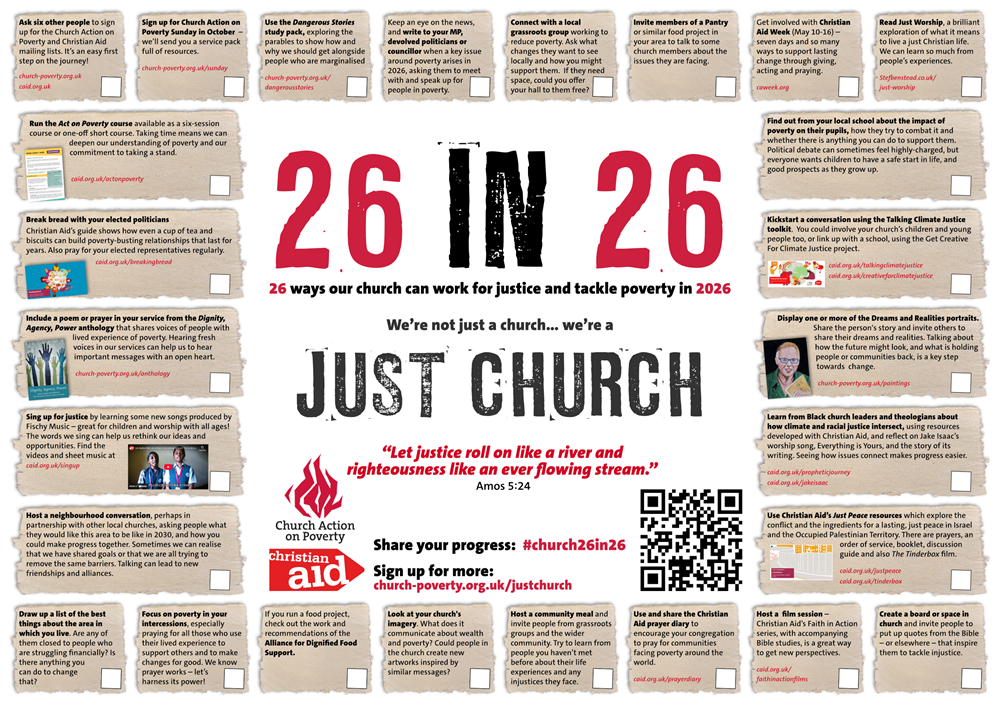
And through projects like 26 in 26, we’re always eager to help churches reflect on their calling to tackle poverty.

I hope and pray that Thursday’s debate at Synod will inspire many more churches to deepen their commitment to tackling poverty. We’re always ready to work with churches, helping them to uphold the dignity of every person; to enable people to exercise their own agency; and to speak truth to those in power, challenging and transforming unjust structures.

The moral case and a 3-point plan for tax reform

Synod is about to debate poverty. Here’s what we long to hear…

How music and art helped churches grasp poverty

Why Christians can’t keep out of politics

26 in 26: 200 churches register for social justice idea

Pilgrims call for more support in low-income neighbourhoods

How should churches address rural poverty?

Faith In The City: why it still matters, 40 years on

Pantries reach 1 million visits – as new research proves they work

Grief is hard enough: it’s time to improve funeral support

New toolkit: Hosting a regional anti-poverty roundtable